

Dear Reader,
In 1846, a Mississippi Court decided: “If a free person of color come from another state into this, and remain beyond a certain time, he may be apprehended and sold.”[1] To support its argument, the Mississippi Court quoted the U.S. Constitution’s Privileges & Immunities Clause “which declares, ‘that the citizens of each state shall be entitled to all privileges and immunities of citizens in the several states.’”[2] As free persons of color could, apparently, lose their freedom by traveling to Mississippi, the Mississippi Supreme Court decided that Black Americans must not be citizens in the free states they inhabit, i.e., that, globally, no Black person is capable of being a citizen of any place.
Thereby, Mississippi usurped the concurrent power of Naturalization from its fellow sovereign States (and from free nations like Mexico) by deciding that Black Americans could only become “denizens in particular states” such that Black Americans “may enjoy in them all the rights of citizenship,” but only “so far as state legislation can confer those rights.” Ohio, Indiana, New York, California, Pennsylvania, Vermont and many other free states disagreed, when they chose to rely upon the old law that citizens admitted as a citizen to a State were ipso facto citizens of the United States.[3] These free States had to defend their concurrent powers to protect Black Americans against slavery States in the Civil War, after they had already defended the original ipso facto basis of citizenship for white, brown, and Black former British subjects in the United States against the attacks of Great Britain in both the War of 1812 and the Revolutionary War.
To be fair, Louisiana, Missouri, and potentially several other slavery States also disagreed with Mississippi as they tended to admit that Black slaves freed in the North were once free, always free.[4] In fact, California’s groundbreaking decision in Biddy Mason v. Smith, quoted the Louisiana Supreme Court at length to justify its decision to free several slaves taken into California by their masters as full citizens of California. For most states, even several in the South, to travel into a free state with one’s slaves was tantamount to a willful manumission that had a permanent legal effect on the slave, making them full citizens in the free states in which they settled.
Despite Mississippi’s particularly noxious beliefs about free Black Americans being mere denizens in the North and West, no State in the United States ever had the power to make denizens as that power resided solely in the king of England.[5] That royal power, according to the unanimous decision of the Founders and Framers of the United States, died with villeinage (i.e., serfdom or feudal slavery) and was never resuscitated in America.[6] The only kind of slavery that had officially managed to take form in the United States was chattel slavery, as indentured servants were not considered slaves but low level working class employees or laborers (see Jane Landers’ work for useful counterpoints in Spanish America, including Florida).
Nevertheless, in Atwood’s Heirs v. Beck, an Alabama Court traced chattel slavery back to the “alien enemies” idea that was created in Calvin’s Case. The idea of alien enemies was used in Calvin’s Case as a basis for denying the humanity of non-Christian people by withholding their most basic human rights of life, liberty, and property. This plugged into the former system of villeinage by creating a class of individual who were non-human, and, thereby, it was used in Atwood’s Heirs to uphold the slavery States’ powers to disrespect human rights with chattel slavery systems according to the concept of villeinage, that all people born in the king’s dominions start out as slaves by birth.
Calvin’s Case was the origin of a “birthright” of slavery if a person was born within the British Empire. The Americans did not quibble (as English judges later quibbled)[7] about feudal slavery being actual slavery. In order to reject Calvin’s Case’s reliance on feudal slavery ideology, the Americans consciously repurposed Calvin’s Case to establish the common law rule of birthright citizenship without Calvin’s Cases’s feudalism.
The paradoxical mixture of feudal and common laws in Calvin’s Case consisted in its illogical citation of the pagan Court of Festus in favor of Paul’s rights as controlling precedent for denying basic human rights to all non-Christian infidels. The Roman Empire was pagan when it recognized Paul’s citizenship by birth in Cilicia, a Roman territory. Paul was a foreign born Jew of a minority group of Jesus followers who may have been a child of Jewish slaves taken in war.
Paul expressed credible fear of political violence in Israel, asserted Roman citizenship, and sought to appeal or transfer venue of his case from Caesaria to Rome. The Court of Festus granted Paul’s request so that Paul could travel into Rome to properly litigate his case, which is regularly cited as “a head of jurisdiction and a ground of protection” in the United States. After hearing Paul’s pleas, Judge Festus “declared: ‘You have appealed to Caesar! To Caesar you will go!’”
A few years before the American Revolution, Massachusetts Governor Thomas Hutchinson asked the Lords of England to help him abridge the rights of Englishmen in the colonies, so they could not similarly appeal their rights to England. In Campbell v. Hall, Lord Mansfield answered his friend by attempting to extend the class of conquered infidel from Calvin’s Case to all British Colonists in America. Therein, Mansfield wrote that, regardless of the religious beliefs of the inhabitants of British colonies, the king could always “put the inhabitants [of America] to the sword or exterminate[] them” because “all the lands belong to him.”[8]
To the scandal of all America, Lord Mansfield resolved “the absurd exception as to pagans, mentioned in Calvin’s Case” to maximize its irrational feudalism by denying rights to all, Christian and non-Christian alike. In Campbell, the exception as to pagans in Calvin’s Case became the rule applied to all Englishmen wherever they are around the globe. Thereafter, leaving the borders of England would destroy any English person’s rights as Governor Hutchinson requested and as Mississippi later held was the case as to all Black Americans.[9]
The Americans forcefully disagreed with Mansfield’s attempt to maximize Calvin’s Case’s feudal errors, and so they rose up for the rights of all English people everywhere when they set forth a new nation upon the common law given by the pagan Court of Festus in Caesarea that secured Paul’s rights as a Roman citizen so that all immigrants were presumed friend, and, thus, immigrants were generally presumed to be legally present in the United States.[10] Calvin’s Case’s paradoxical use of Paul’s case to undermine the birthright citizenship of non-Christians was further extended as originating in feudal slavery in Sir Thomas Grantham’s Case to enslave a non-white man considered a “monster,” even after converting to Christianity, for having a birth defect.[11] Prior to this case, Sir Thomas Grantham was responsible for crushing the multi-racial Bacon’s Rebellion in Virginia in 1676 through fraud, which led to the invention of the white race and white privileges at sometime around 1700 that Atwood’s Heirs candidly cited as the treasonous and anti-American basis of the Southern chattel slavery institution.
After the Civil War, in the Slaughter-House Cases the U.S. Supreme Court extended the Southern interpretation of privileges and immunities, symbolized by the Mississippi case Leech v. Cooley quoted above, to destroy the rights of the white working class as though the Fourteenth Amendment’s Privileges or Immunities Clause made all Americans denizens. Despite some push back in cases like United States v. Wong Kim Ark and Boyd v. Nebraska ex rel. Thayer, Congress extended this denization first to Chinese immigrants in the late 1800s and then to all immigrants in 1924. The Slaughter-House Court acknowledged that when the Thirteenth Amendment “intended to abolish African Slavery,” it also included language that “equally forbids Mexican peonage or the Chinese coolie trade.”
Yet, Slaughter-House did not stop Louisiana from destroying white working class rights based upon the Court’s “slavery argument,” as explained in Plessy v. Ferguson.[12] Slaughter-House’s “slavery argument” held that the postbellum amendments may have abolished race-based slavery, but they only abolished race-based slavery. Whatever situation white laborers found themselves in when the first Constitution was drafted and ratified in the late 1700s was, apparently, to remain what all Americans faced under the post-Civil War Amendments.
However, Slaughter-House did not apply the rights of white workers, then existing, to the facts of the case. Rather, it distinguished The Case of Monopolies, and became an exemplar of C.S. Lewis’s observation: “What is new usually wins its way by disguising itself as the old.”[13] As most of the Originalists on the Court do today, Slaughter-House disguised itself as a recapitulation of the old rights of white American laborers, only to scandalously allow a new system of denization to capture all laborers in America, white, brown, and Black in a fate equal to or even worse than slavery (potentially worse, perhaps, because we no longer even have language to name it).
Slaughter-House sowed the seeds of several false histories of the former British American colonies that helped the United States distance itself from its racist past without actually resolving the Court’s former errors. These false histories tended to appropriate Irish-American history, as though all white Americans faced the prejudices the Irish faced, and that somehow this prejudice was no worse than the chattel slavery Black Americans endured. The false histories of Irish immigration-as-“white”-immigration was purposely twisted around the Irish past to blot out the chattel slavery the British imposed upon the Irish centuries prior to the existence of the British American colonies that was not racialized according to the color of skin until sometime after Bacon’s Rebellion.
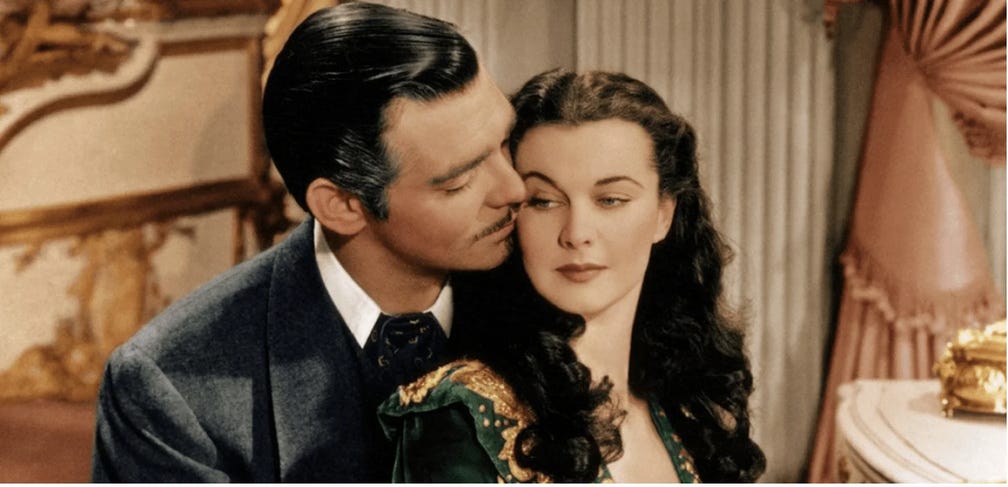
Perhaps the most egregious example of this racist double-play on Irish history was exemplified by Scarlet O’Hara in Gone With the Wind, a fictional daughter of Irish immigrants who sought to wistfully justify chattel slavery as gallant and even refined. Now, in Trump v. Barbara the U.S. Supreme Court has been asked to embrace similar paradoxes by interpreting Wong Kim Ark as though it never pushed back on the denization of all Americans implied in Slaughter-House by interpreting Wong Kim Ark as an expression of denization such that the President-as-king has the final say over the citizenship rights of all Americans whether or not they complied with the Naturalization Law of the federal government. But, judging from misogynistic cultural developments in America over the last several years, the idea that Americans are all basically denizens without citizenship rights or privileges is not very surprising.
This examination of Hollywood’s role in covering up the actual origins of U.S. immigration law will continue in my next letter, beginning with a comparison of Olivia Colman in The Favourite with Glenn Close in The Wife. It seems that the complex misogyny exemplified by the Academy of Motion Picture Arts and Sciences’ choice to honor Colman by snubbing Close demonstrated that Scarlet O’Hara remains the quintessential Hollywood female archetype, according to which all movie actresses are judged. Abusing the crown to cover for American racism and misogyny is a tale at least as old as Gone With the Wind, and it continues today at the expense of Hollywood’s best female talents. But this is a thought for another post.
Yours Cordially,
Joshua J. Schroeder, Esq.
[1] Leech v. Cooley, 14 Miss. 93, 99 (Miss. 1846).
[2] Id. (quoting U.S. Const. art. IV, § 2, cl. 1).
[3] Joseph Story, Commentaries on the Constitution of the United States § 1687 (“Every citizen of a state is ipso facto a citizen of the United States.”), quoted by Boyd v. Nebraska ex rel. Thayer, 143 U.S. 135, 158–59 (1892).
[4] Atwood’s Heirs v. Beck, 21 Ala. 590 (Ala. 1852), citing Josephine v. Poultney, 1 La. Ann. 329 (La. 1846), citing Lunsford v. Coquillon, 2 Mart. (N.S.) 401, 408 (La. 1824); see also Winny v. Whitesides, 1 Mo. 472, 475 (Mo. 1824) (“We are clearly of opinion that if, by a residence in Illinois, the plaintiff in error lost her right to the property in the defendant, that right was not revived by a removal of the parties to Missouri.”).
[5] 2 James Wilson, Collected Works of James Wilson 1050 (2007) (“The power of denization is a high and incommunicable portion of the prerogative royal.”).
[6] Id. at 1081 (fuit servitus “slavery is a thing of the past”).
[7] English judges referred to villeinage or feudal slavery as the state of being “equally unfree” rather than being in a state of slavery. See John Baker, An Introduction to English Legal History 502 (5th ed., 2019).
[8] Campbell v. Hall (1774) 1 Cowp. 204, 209 (Eng.).
[9] Compare id., with Leech, 14 Miss. at 99. This dispute is still alive, symbolized by the 2008 clash of the U.S. Supreme Court with the House of Lords in their opposite conclusions in Boumediene v. Bush, refusing to limit habeas corpus to the national borders of the United States according to the English feudalism in Rex v. Cowle, and Ex parte Bancoult that extended Campbell v. Hall.
[10] 2 Wilson, supra note 5, at 1046 (“In ancient times, every alien was considered as an enemy. The rule, I think, should be reversed. None but an enemy should be considered as an alien.”); see Chisholm v. Georgia, 2 U.S. 419, 462 (1793) (“The Parliament form the great body politic of England! What, then, or where, are the People? Nothing! Nowhere! They are not so much as even the ‘baseless fabric of a vision!’ From legal contemplation they totally disappear! Am I not warranted in saying that, if this is a just description, a government, so and justly so described, is a despotic government?”).
[11] Sir Thomas Grantham’s Case (1687), 3 Mod. 120, in John Baker, Sources of English Legal History: Public Law to 1750, at 453 (2024).
[12] Plessy v. Ferguson, 163 U.S. 537, 542–43 (1896) (quoting Justice Bradley’s characterization of The Slaughter-House Cases’ decision as “‘the slavery argument’” by way of The Civil Rights Cases).
[13] C.S. Lewis, The Allegory of Love 11 (1968).