

Dear Reader,
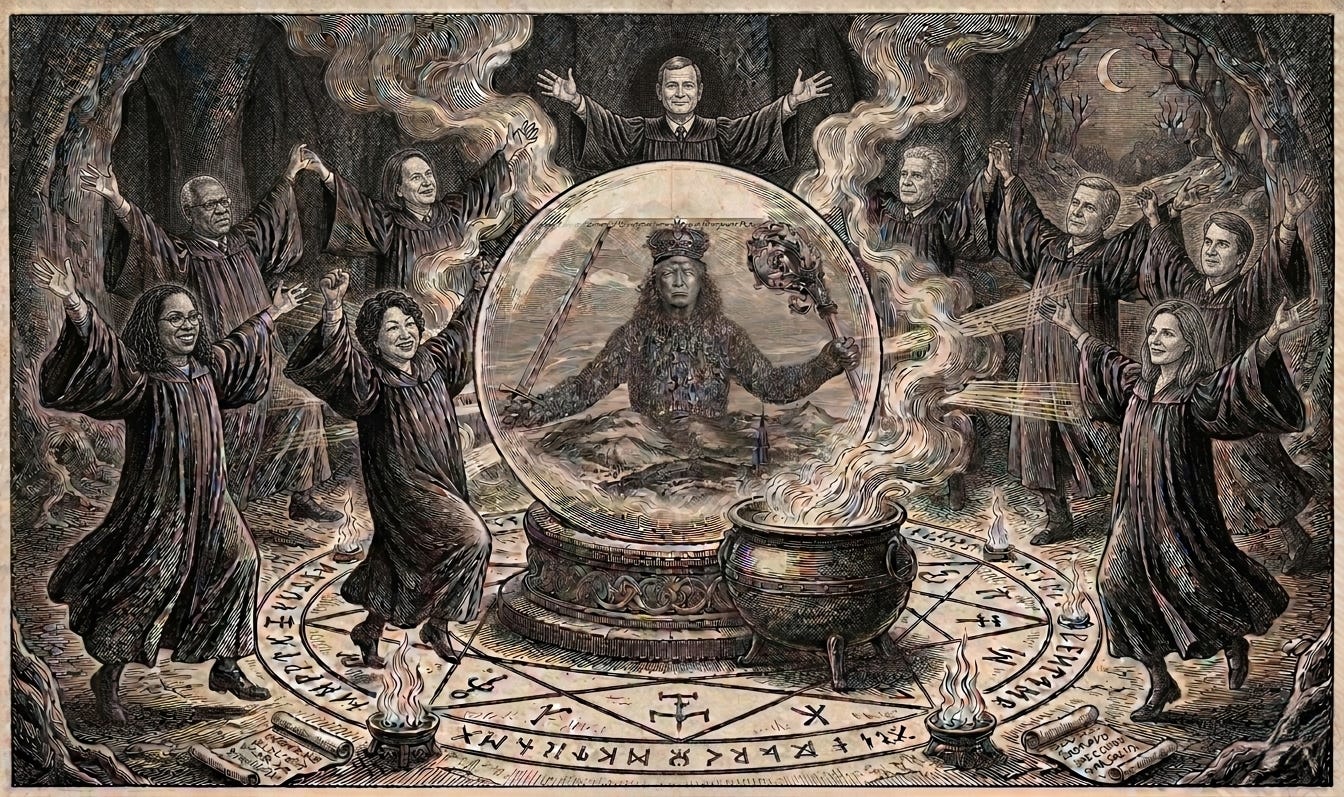
Feminist scholars recently shined a light on the role of Hobbesian prophets in the rise of dictatorships. Prophets, or charlatans styled as prophets, were at work behind the rise of Oliver Cromwell, Maximilien Robespierre, and Napoleon Bonaparte. Many of the prophets were women like Suzette Labrousse, whose mystical role inspiring political change in revolutionary France was not entirely unlike the role the current U.S. Supreme Court seems to be filling today.
There were many others, including Catherine Théot, Elizabeth Poole, and Mary Pope. Some, like Anna Trapnel, eventually turned their considerable political powers against the dictators they once supported, perhaps, reminding us of the mercurial fictional character Aunt Lydia from the celebrated books of Margaret Atwood. Thomas Hobbes anticipated the threat such women posed to his favored government of absolute monarch by attempting to cede their powers to the dictator himself by calling him “the sovereign prophet.”
At the bottom of Hobbes’s struggle with the, largely female, prophetic powers of his time was a sheer realist calculation about religious fanaticism drawn from claims of divine sovereignty. Hobbes likely considered prophecy a product of the general madness of all humanity (his diagnosis), which he tried to corrupt in service of his favorite form of government: absolute monarchy. Despite the regrettable beheading of Charles I, largely due to these prophetic pronouncements, the prophets of Hobbes’s time mostly served the political absolutism he preferred in Cromwell.
Louis XIV and Charles I’s divine right of kings was successfully challenged by several female prophetesses who claimed God’s sovereign blessing on themselves as female servants of the Lord. However, the very existence of King James II, who is the namesake of New York in America and primary architect of the infamous African-American Slave Trade, proved the limits of political-prophetic movements to make lasting change. It was not until the American Revolution that the British crown would be permanently disrupted when New York City, the seat of the British Empire and symbol of its many horrifying sins, was taken in open battle by Republicans who followed the mighty poetic pronouncements of New Yorker Ann Eliza Bleecker against tyranny that appeared in the humble form of art, rather than prophecy.
Many, like Bleecker, followed in the wake of Phillis Wheatley’s humble mission built upon her simultaneous veneration and correction of John Milton’s previous works. The ostentatious English prophets, including Milton, were abandoned in America for the humbleness of making an appeal to heaven in prayer. But the prayerful women who helped lead the American appeal, writing mostly in poetic forms, filled the same inspirational role as the former prophetesses held, but without committing the sin of presumption by violating Luke 17:1-2 and Revelation 22:18-19.
The American Revolutionaries never claimed authority from divine sovereignty the way that the English and French prophets had done to swear violence on monarchs. King George III was deposed in America according to nature, heaven, or God’s respect for the choice of the American people to depose the king according to their natural rights and liberties. As God respected the choice of the people of Israel to choose a King in Samuel, even though it was a sin, God respected the choice of the people of America to repent of this very same sin by casting off the crown of Great Britain on July 4, 1776.
The idea of American sovereignty, and its interaction with the religious while never establishing a religion or requiring worship of any kind is a singular contribution to the science of statecraft led by the Americans of 1776. The people are sovereigns, because God (or nature) made them that way,[1] and God (if he, she, or they exists in the first place) respects the people’s sovereignty as an aspect of people created by God or nature even unto sin and error, as the Israelites had exemplified to the eyes of the world time and again. In 1776, the Americans made a different choice that God respected according to the natural sovereignty of the people through their practice of humbly appealing their grievances to heaven and publicizing their grievances in the Declaration of Independence for the consideration of the world.
As Hannah Arendt later clarified, with affection, the Americans retained the manyness of the people in its idea of popular sovereignty that was corrupted in the Soviet Union and other Marxist and Leninist experiments.[2] Thus, when the American laws and constitutions say “the people,” they simply mean the people in their individual and group capacities as natural beings created by nature and God.[3] As Arendt noted, the people’s majesty itself arose from their very manyness.[4]
As Communism and Socialism would later do, the British crown theoreticized the people as a giant mass with big capital letters: The People, The Mob, The Rabble, or the Peanut Gallery.[5] The most extreme of British royalists actually imagined The People as a giant monster called Leviathan who united as one man in the monarch.[6] One of these royalists was Jeremy Bentham who actually appealed to this one man to punish the Americans for daring to break away from the fold without permission.[7]
Bentham’s appeal did nothing, because human beings are individuals who do not have a way of uniting as one man except in their imaginations.[8] The great and terrible Leviathan is like the Wizard of Oz: a boogie monster to chorale individuals into groups through fear and wonder. The Leviathan never was something a royalist could depend upon to keep the Americans in line, even if it could be used to enchant them with affection and fear as the Wizard of Oz did to all the munchkins of munchkin-land.
The French must have seen how Bentham appealed to the great monster in his mind as though it were sovereign without avail, and, yet, allowed themselves to be convinced by Bentham to repeat this error. Then, like psychopaths, they began chopping off their own heads in what is now known as the Reign of Terror. As the Americans knew, the French abandoned their better lights in the Baron de Montesquieu when they embraced Rousseau’s union sacrée according to Bentham’s original appeal to the one sovereign man that Thomas Hobbes called Leviathan.[9]
It is, apparently, psychopathic to keep repeating the same behavior while expecting different results. And, yet, a ridiculous pretender, who would be king, managed to take the Presidency twice. There are now talks of a third (unconstitutional) term.
But the pretender, himself, was never the source of the American pride and despair that put him in power. He was and remains only a symptom of these ancient sins of humanity that are remarked upon time and again by sages and philosophers in the West, beginning with Aristotle. The strategies of a Leviathan or Wizard of Oz to manipulate the feelings of the people to accumulate power merely theorizes that the vices of humankind are more stable than its virtues for world building and statecraft.[10]
In the end, the Americans confessed these vices of pride and dejection, despair and presumption, were inescapable realities of their hearts that disrupted their virtues of hope, humility, and magnanimity. But unlike Hobbes’s institution of an absolute ruler called Leviathan, they devised a system of separated powers to check these vices so that human virtues in government could survive, if not potentially flourish.[11] The form of government favored by the Americans was, therefore, a limited federal government with several limited State and local governments that aimed to maximize the freedom and choice of the people.
This system of separated powers seems to have put too much pressure on the judiciary.[12] Over the centuries, the judiciary faltered in its duty to unify the nation under one Supreme Court, first by nationalizing slavery in Dred Scott v. Sandford to cause a Civil War. Then, by extending Dred Scott in the Slaughter-House Cases to permanently undermine the limited nature of American government that led to the development of eugenics, Buck v. Bell, and finally Hitler’s plan in Germany.
Despite several obvious structural contradictions, the Court largely became a prophet of the absolute powers of Leviathan. In fact, the U.S. Supreme Court propagated our despair anew when the Nuremberg prosecutor, Justice Robert H. Jackson, appeared to suggest that the Court, rather than the people, creates the constitution in Brown v. Allen.[13] Emphasizing the paradoxical nature of this vein of potentially treasonous realism, the Roberts Court was recently inspired by it to upend stare decisis while announcing “rule[s] for the ages.”
The Supreme Court appears to have told us that it believes that it creates the constitution.[14] It apparently believes that the Court is the sovereign that gives form to national government, not the people. Therefore, the Court appears to be the first pretender to the throne of American sovereignty as a Hobbesian prophet tasked with dubbing the administrators of government with legitimacy.[15]
Every awful thing that led to Trump’s two-term presidency can be traced back to the Court’s populist advertisement of treasonous realism. Both Republicans and Democrats heard the Court pretending to the people’s power and believed that they had to capture it for their political ambitions to succeed. Back in the 1980s or even before, the Court’s usurpation of the people’s power to make and remake their constitutions was already perfected to generate the populist presumption and despair that created President Trump.
In his royalist tract, Leviathan, Thomas Hobbes observed that despair is merely another side of presumption; pride merely another side of dejection; and advocated that absolute royals should use this “Madnesse” among the people to “enrowle a legion.”[16] In the mid- to late Twentieth Century, Americans presumptuously took John Adams’ prescription for independent judging as an automatic cure for arbitrary power. The Court recognized the people’s indulgence of its power and scandalously misused it to gaslight the people with Hobbes’s insult of popular insanity to solidify its prophetic power into the future without respecting the popular indulgence.
But the era of presuming that the Court is always right is over. The people are presently realizing the pivotal part they had in facilitating the Court’s fractious course. They may choose to repent and do better, which may entirely upend the political plans of both the Democrats and Republicans for the Supreme Court.
The Supreme Court is a co-equal sovereign with the President and Congress,[17] but each co-sovereign is vested with the people’s sovereignty, held in trust according to the limits of a written constitution drafted and ratified by the people. The entire purpose of the Court was to be a non-political tribunal where the entire nation could peacefully settle its grievances before the country devolved into Civil War.[18] John Adams specifically defended the Court’s independence through life-tenure during good behavior, believing that political slant and bias could be avoided by structurally isolating the judges from the traditional levers of political control.
However, the Supreme Court failed to peacefully resolve the nation’s differences when it decided Prigg v. Pennsylvania and Dred Scott v. Sandford. Despite explicitly being characterized as a tyrant king by Chief Justice Taney in chambers, President Lincoln still dared to imagine that the fledgling nation could be born again. Eventually, the Thirteenth, Fourteenth, Fifteenth, and Nineteenth Amendments accomplished the rebirth of the American project, keeping the system of independent courts originally invented by John Adams.
Judicial independence is known to be the only original contribution to the science of statecraft attempted by the United States. It was one of the only things that the Americans devised through an original, positive development of the law to distinguish the American governments from others. It would, therefore, be a travesty if John Adams’s theory of judicial independence, as adopted nearly verbatim in Article III of the U.S. Constitution, is disproved by the Roberts Court through sheer unforced corruption of the bench with Hobbes’s natural religion of the divine right of the king’s prophets that John Adams himself decried in his Dissertation on the Canon and Feudal Law to justify the Revolutionary decision of the Americans to permanently separate church and state under the First Amendment.
Yours Cordially,
Joshua J. Schroeder, Esq.
[1] 1 James Wilson, Collected Works of James Wilson 445 (2007) (“The dread and redoubtable sovereign, when traced to his ultimate and genuine source, has been found, as he ought to have been found, in the free and independent man.”).
[2] Hannah Arendt, On Revolution 66, 250 (1990).
[3] U.S. Const. pmbl., explained by Chisholm v. Georgia, 2 U.S. 419, 455–56 (1793) (“In all our contemplations, however, concerning this feigned and artificial person [i.e., the State], we should never forget that, in truth and nature, those who think and speak and act are men.”).
[4] Arendt, supra note 2, at 93 (“The word ‘people’ retained for [the Americans] the meaning of manyness, of the endless variety of a multitude whose majesty resided in its very plurality.”).
[5] Chisholm, 2 U.S. at 462 (“The Parliament form the great body politic of England! What, then, or where, are the People? Nothing! Nowhere! They are not so much as even the ‘baseless fabric of a vision!’ From legal contemplation they totally disappear! Am I not warranted in saying that, if this is a just description, a government, so and justly so described, is a despotic government?”).
[6] Thomas Hobbes, Leviathan frontispiece (A.R. Waller ed., 1904).
[7] Jeremy Bentham, Short Review of the Declaration, in John Lind, An Answer to the Declaration of the American Congress 107, 118 (1776) (appealing to the British empire to “unite as one man, and teach this rebellious people, that to say the connection, which bound them to us, is broken, is not to break it”).
[8] Joshua J. Schroeder, A Court of Chaos & Whimsy: On the Self-Destructive Nature of Legal Positivism, 29 Cardozo J. Equal Rts. & Soc. Just. 663, 665 (2023) (noting that legal positivism cannot be reliably defined, because it is “a theory that facilitates a potentially unlimited number of imaginary experiments”).
[9] Arendt, supra note 2, at 150, 241 (noting that Montesquieu’s “role in the American Revolution almost equals Rousseau’s influence on the course of the French Revolution”); Jean Jacques Rousseau, The Social Contract 218–19 (Rose M. Harrington trans., 1893) (celebrating Hobbes’s combination of church and state and embracing the paradoxical nature of humankind).
[10] Hobbes, supra note 6, at 46–48 (proposing that absolute monarchy should be built upon a diagnosis that all humanity is reliably insane).
[11] U.S. Const. arts. I–III; see James Otis, Collected Political Writings of James Otis 241 (Richard Samuelson ed., 2015) (rejecting the “Hobbesian maxims” of force and fraud).
[12] John Adams, The Revolutionary War Writings of John Adams 292 (2000) (proposing the separation of powers including the life tenure and independent salaries of federal judges as sufficient to secure the judiciary as a reliable check on the President and Congress).
[13] Brown v. Allen, 344 U.S. 443, 540 (1953) (Jackson, J., concurring in the result) (“We are not final because we are infallible, but we are infallible only because we are final.”), explained by Linda Greenhouse, “Because We Are Final”: Judicial Review Two Hundred Years After Marbury, 148 Proc. Am. Philosophical Soc. 38, 38–39 (2004).
[14] Greenhouse, supra note 13, at 39 (“‘The Constitution does not found judicial review; rather, judicial review invents the Constitution.’” (quoting Paul W. Kahn, The Reign of Law: Marbury v. Madison and the Construction of America 169 (1997)).
[15] Hobbes, supra note 6, at 315–18 (“[T]he Prophet is the Civill Sovereign. . . . Every man therefore ought to consider who is the Soveraign Prophet; that is to say, who it is, that is Gods Vicegerent on Earth.”); see Oliver Wendell Holmes, The Path of the Law, 10 Harv. L. Rev. 457, 461 (1897) (“The prophecies of what the courts will do in fact, and nothing more pretentious, are what I mean by the law.”).
[16] Hobbes, supra note 6, at 46–48.
[17] Baker v. Carr, 369 U.S. 186, 226 (1962).
[18] Martin v. Hunter’s Lessee, 14 U.S. 304, 373–74 (1816).