

Dear Reader,
On April 28, 2026, King Charles III gave a speech in Congress designed to cement the “special relationship” between the United States and the United Kingdom. Given the general paradox of the U.K.’s recent attempts to remain aligned with its old colonies, that King George III had tried to ruin, remembering the origins of this love-hate paradox in the old chattel slavery system is necessary. The story began in 1772, when Somerset’s Case expelled slavery from England to free a Black American slave, but enforced a firm limitation of this common law of freedom at the borders of England.
Sir William Blackstone presaged Somerset’s infamous geographic limitations in his Commentaries where he expounded page 17 of Calvin’s Case in an argument “calculated to cut off the noblest inheritance of the colonies.” Thus, Founder and Framer James Wilson turned to Lord Coke’s opinion in Calvin’s Case to note how Coke had made infidels perpetual enemy aliens “by the language, tortured surely, of christianity itself.” Blackstone was thinking of this passage of Calvin’s Case when he wrote:
Our American plantations are . . . obtained . . . either by right of conquest and driving out the natives . . . or by treaties. And therefore the common law of England, as such, has no allowance or authority there; they being no part of the mother-country, but distinct, though dependent, dominions.
Despite Wilson’s fine protest against this passage, Blackstone’s anti-American sentiment was extended into America in the worst slavery cases of the U.S. Supreme Court. To be sure, Somerset’s Case was extended in both Prigg v. Pennsylvania and Dred Scott v. Sandford to emphasize the lack of common law freedom in America. It took generations of suffering and an unnecessary, bloody Civil War to finally extend the common law of freedom that England had attempted to exclude from America into America. Yet, the preface of this extension of freedom liberally to all Americans began in James Wilson’s rejection of Blackstone’s attempt to treat all Americans, including Englishmen in America, as perpetual enemy infidels.
It is, perhaps, one of G.K. Chesterton’s paradoxes standing on its head to get attention, that the Americans and the British remain so entangled with each other now. Around a century ago, Chesterton had to explain to Americans why their Revolution was so important to the English people. And now, the Americans apparently must tell the English why their pre-1066 common law, as extended to benefit only the inhabitants of England in Somerset’s Case, is so vital to the Americans as members of the former British Empire.
In the United States, the Ninth and Tenth Amendments clarify that residual or unenumerated powers and rights, especially the right to rule known as sovereignty, is reserved to the people. In England this sovereign right to rule is reserved to the crown as its prerogative. Perhaps confusingly, the United States enumerated certain powers that were previously considered a part of the crown’s prerogative in the executive, legislative, and judicial branches and reserved to the States a “police power” to legislate upon public safety, healthcare, and (originally) immigration.
Even more confusingly, the United States extended the English common law system that some English scholars believe created the crown’s prerogative powers. This created a scandal in the early Republic with the creation of the Alien & Sedition Acts to, apparently, codify these prerogative powers as American common law. In 1799, the Virginia legislature responded to the possibility that the English common law had unleashed the usurpation of the Alien & Sedition Acts of the United States by explicitly rejecting the unlimited common law of England as inapplicable in America.
Monarchy was so unpopular in the fledgling United States that some States would rather abandon the English common law, at least at the federal level, than risk reintroducing monarchy here. St. George Tucker, one of the first federal judges in Virginia, carefully explained the risks of using what he called the “unlimited” statutes and common laws of England in federal courts. At the time, the common law in England was said to justify the prosecution of high crimes against the crown including sedition and libel by writ of scandalum magnatum as though the crown’s right to rule was a common law, as opposed to a feudal law.
Questions of the English common law’s endorsement, mere allowance, or rejection of the feudal (i.e., monarchical) law still plagues Great Britain. For example, in 2022 David Kershaw, the former Dean and current Professor of Law at the prestigious London School of Economics, published a very interesting article about the Glorious Revolution of 1689 originating the current regime of royal prerogative as limited by statute in Parliament. However, Professor Kershaw admitted his article was the very first to take the 1689 Parliament at its word when it legitimized the reign of William & Mary as a convention without a king in it.
It appears that Kershaw intended to honor the Americans when he thought of Philadelphia’s later constitutional convention as a potential way to reframe English power and law after 1689 as though it were limited. However, doing so might confuse things further, because the whole concept of a Parliament (at least according to Walter Bagehot) is to unify powers in one body, which has one head — the monarch. To an American, the Glorious Revolution is instructive, as it revealed, again, what lengths a Parliament would go to shore up the semblance of a good government even if it were treasonous and/or scandalous from the vantage point of the monarch it unseated.
The fact that the Parliament, itself, apparently has more power than simply to appear and disappear when the king calls it is an important revelation. But nothing about the Glorious Revolution shifted the union (as opposed to separation) of powers that the Parliament represents, especially as its first apparent act when it constituted itself without a king in it was to put a king and a queen in it again. As noted by the majority of English scholarship, aside from Kershaw’s wonderful article, the royal prerogative was not redefined by the Parliament, it was reestablished and reconstituted in a new monarch.
It is also questionable what Kershaw’s new analysis stands to help England gain by seeing the Parliament of 1689 as comparable to a Philadelphia constitutional convention. The United States consciously and openly created a system of separated powers, but the Parliament of 1689 clearly did not separate its powers from the prerogative royal. Nor did the prerogative diminish as if it were an executive power only; as though the chief executive officer of England, the monarch, wasn’t also the chief legislative, judicial, and religious officer of the nation too.
The most fundamental prerogative power of English monarchs is to write and rewrite the constitutions of its subjects, which is an original legislative power. This power, affirmed in 1774 in Campbell v. Hall to uphold the crown’s taxation of the inhabitants of the Colony of Grenada without representation began in 1066 England at the Norman Conquest. As the English had been subjugated, so too, Blackstone theorized, the rest of the empire, starting with Wales, became conquered into English liberty.
The same idea of freedom-by-conquest paradoxically excluded even the inhabitants of the Scottish town of Berwick, on the very border of England, from their common law rights and privileges in Rex v. Cowle. In 2008, the U.S. Supreme Court distinguished Cowle in Boumediene v. Bush to extend American common law to Guantanamo Bay, Cuba. In that same year, the House of Lords reaffirmed these royal powers by conquest, when Queen Elizabeth II’s Order in Council banishing the Chagossians from Diego Garcia was deemed fundamental legislation enacted outside of Parliament.
Kershaw’s reframing of England around the American idea of separated and limited powers fails to acknowledge the reality that the prerogative royal, in England, appears to be a feudal law that is treated as gravior lex (the higher law). The concept of prerogative arises from the idea of land-as-conquered to exclude common law rights from potentially all people inhabiting any land starting with the inhabitants of England, whose original Conqueror William I used the common law to rebrand feudal slavery, i.e., villeinage, as freedom (a paradox that candidly pervaded Somerset’s Case). Kershaw did not face the reality of the prerogative powers being a union of legislative, executive, and judicial power in the crown, and so he could not have hoped to analyze the English system of devolution in contradistinction to American federalism.
Nevertheless, Kershaw’s attempt to Americanize English power (even if it were novel to academia in 2022) is a decades’ old, populist position in Great Britain and America. Indeed, the legal bases of the Brexit decision that Kershaw seemed to agonize over was vindicated at the time of Brexit by populist analogies to the American Revolution. To be fair, proponents of the European Union have also analogized itself to the American Union that was brought about in the same revolutionary period in America.
The most interesting thing about Kershaw’s thesis was that, by revising the year 1689 according to a newly popular hindsight provided by America in 1776, the meaning of Lord Coke’s 1611 opinion in the Case of Proclamations changes completely. In that case, Coke stated “the King hath no prerogative, but that which the law of the land allows him.” Generally speaking, “the law of the land” is interchangeable with the English common law, which is a phrase repeated in the Supremacy Clause of the U.S. Constitution to denote by common law which laws are gravior lex in America.
But what Coke meant in his statement is not clearly that the common law created the royal prerogative, as he may have seemed to have said, as Coke actually said that the common law allowed the prerogative and potentially could therefore disallow it. As James Wilson noted in his lectures, the common law in Coke’s meaning was acting as gravior lex in contradistinction to the royal prerogative, which was not. If Coke meant that the common law had an active role shaping and, at times, limiting the royal prerogative, then the royal prerogative was sub graviori lege (under the higher law) as American Founder St. George Tucker maintained.
As Kershaw explained, there are many cases prior to the American Revolution that insisted that the royal prerogative was “grounded upon the common law” such that the Glorious Revolution “repaired and revived . . . the ancient constitution.” These cases were seen as a horrid corruption of the common law by many of the American founders. And Lord Coke, himself, committed the most fundamental blunder of this corruption in his decision in Calvin’s Case.
The inaugural Justice of the U.S. Supreme Court James Wilson called this corruption the bastard mother of Blackstone’s Commentaries, which he dubbed the bastard child, to signify its illegitimacy on this point. Nevertheless, in the U.S. Supreme Court’s first constitutional case of great importance, Chisholm v. Georgia, Wilson extended the common law writ of assumpsit as a legitimate basis for a private individual to sue a sovereign State. But Wilson perished too soon after the Alien & Sedition Acts were enacted to see what his response to these Acts would be.
In response to the popular argument in those days that the Alien & Sedition Acts were merely a restatement of English common law, St. George Tucker took the corruption of the English common law more seriously. Perhaps it was necessary to stake out the English common law as completely corrupted by a monarchical usurpation as a total failure that cannot be fully trusted as gravior lex in the United States. What mattered, and what still matters, is what the U.S. Constitution and the constitutions of the several States allow.
But here again we circle upon the central issue of concern to Kershaw and many other eminent scholars of today: whether one law allows another law, which Coke had addressed in the Case of Proclamations. As described in more detail in Coke’s decisions in Dr. Bonham’s Case and the Case of Monopolies, the constitutional allowance or disallowance of statutes and proclamations, according to Coke, is facilitated by the common law. The very concept of judicial review, adopted by the Americans and upheld in the celebrated case Marbury v. Madison, is a use of the common law as gravior lex to give overriding power to our written constitutions.
The theory by which they enshrined a novel system of separated powers and federalist principles was according to the mythical common law as it existed prior to the Norman Conquest of 1066. In the time of the American Revolution, the English jurists betrayed their previous holdings of the immemorial nature of the English common law — that it was rooted in a past older than our records, and potentially coeval with the existence of common human beings. In its place, the jurists of England maintained the existence of an immemorial social compact that ceded all power to a conquering royal crown.
Professor Kershaw understandably downplayed England’s pre-1066 history as it was already authoritatively rehashed by eminent legal historian Frederic William Maitland who denounced all Coke’s citations to myths and legends of King Arthur in the time before 1066 by degrading the Mirror of Justices as a fiction. However, Justice Wilson cited the Mirror in Chisholm as authority for the position that the common law controlled the king, and thereby it must also at a minimum control the States. Even the dissenting Justice Iredell maintained the petition of right in contradistinction to the writ of assumpsit as a way to find that the States were suable in federal courts.
Despite the current Supreme Court’s passionate disagreement with Chisholm as though it were a potential cause of an uproar of the mob, the Supreme Court generally reaffirmed Chisholm’s rejection of the petition of right in favor of general common law principles. The petition of right was filed in the office of the monarch, which simply does not exist here. The general point emphasized by William Blackstone, a royalist defender of the common law, is that even if the United States had chosen to crown a king in America it would still be able to have sued the king.
This general belief remained in the United States until, in 2019, the Supreme Court overruled Nevada v. Hall according to a novel theory of prerogative power that devolved upon the several States through the U.S. Constitution. In Franchise Tax Board v. Hyatt, the U.S. Supreme Court overruled Hall’s decision that each State retains sovereign immunity according to principles from the law of nations. Instead, the Court adopted a candidly British view of the Constitution by finding that sovereign immunity devolves upon the States from the U.S. Constitution such that the States cannot choose whether or not they respect it.
The upshot is that sovereign power and the right of the people of each State to rule is not reserved to the States and the people by the Ninth and Tenth Amendments, but the U.S. Constitution grants or devolves the powers the States possess. This resembles the British praecipe writ, which the British crown anciently used to centralize its authority to effectively unify the kingdom under one head. This Britianification of America is extremely new, and oddly appears to coincide with Britain’s populist Americanization of Brexit and Professor Kershaw’s analysis.
For the Americans, the new devolution of right and power to the people and the States in cases like Hyatt appears to fit St. George Tucker’s definition of usurpation as the union of the sovereign power of the people with the government. In England, this unification of power with the government is so ordinary that Professor Kershaw casually names it the public power of the government. It is the power that theoretically comes from the common people in order to presumably control the common people (allegedly for their own good).
Judge Tucker explained that the union of sovereign power with the government could come by an official act, like the decision of the Parliament of 1689 to enthrone William & Mary in England. But it can also occur by several imperceptible steps, such that the usurpation can occur in America if the people fall asleep; i.e., if they fail to stay alert to violations to their rights. According to Professor Kershaw, potentially this is what must have occurred after 1689 to reintroduce unlimited prerogative powers back into the English government.
But we are told by many scholars of the English constitution that the union of powers in one body, with one monarchical head is the entire point of a Parliamentary system of government. This union of powers in Parliament is intended to unite the absolute power of the people through the common law so that this power can be used, theoretically, to benefit the people. But the controversy over Godden v. Hales still stands, where the king was held to be above the law in pro bono publico (for the public good), where the king’s power was upheld to dispense with the law to benefit the people.
In Judge Tucker’s arguments that the Alien & Sedition Acts were unconstitutional, he noted that such a crown might assassinate his own children according to a theory that murdering his son was for his son’s own good. In other words, Tucker maintained that the promise of salus populi suprema lex esto (the good of the people is the highest law), which denotes the proper end of government, should not be allowed to justify the means. Absolute power of the people should never be united with the government, because it would never tend toward the good of the people for the people to permanently strip themselves of their sovereign powers and rights.
If a government tends to assert an absolute power to oppress the people, the people retain their right and duty to oppose such corruptions. This right and duty, which was boldly announced in the Declaration of Independence, is confirmed by the common law, which includes the folk-right of the common people to what is their own. As Tucker noted, in England, these common law rights were tested by several challenges wrought by the feudal power of monarchs to control or acquire what is and always was due to the common people of England, in contradistinction to their rulers.
In order for the U.S. Supreme Court to finally become corrupted by a British theory of devolutionary power, starting in 2019, Sir Paul Vinogradoff had to infiltrate American academia. This Russian-born British royalist influenced Maitland especially in his voluminous writings about the common law folk-rights of England, which characterized common law rights as though they established absolute powers rather than opposing absolute powers. It appears that, ultimately, the devolutionary laws the Supreme Court adopted in Hyatt to was not American at all — it was Vinogradoff’s.
The Americans were always defenders of English common law rights. One might guess that if it were possible, the English people would have chosen to correct their Lords and Ladies when they abdicated the vital spirit of the English people for the elitist diatribes of a Russian monarchist (i.e., Vinogradoff). Long before the Peterloo Massacre that the English people suffered in their struggle to secure English working class voting rights, the Americans boldly contested the rights of the English like this:
The Parliament form the great body politic of England! What, then, or where, are the People? Nothing! Nowhere! They are not so much as even the “baseless fabric of a vision!” From legal contemplation they totally disappear!
As confirmed in these words by Justice Wilson in a controlling opinion maintaining the common law rights of the English despite their despotic form of government, the common law as received in America is not the same common law received in England. In one way or another, the English abandoned their Lord Coke, whose constitutional opinions the Americans generally embraced and extended with careful modifications. Whether by Judge Tucker or Justice Wilson, the Alien & Sedition Acts were a travesty that are mostly repealed and expired in America, because they threatened to usurp the sovereign right and power of the people to rule.
The last vestige of the Alien & Sedition Acts, the Alien Enemies Act (“AEA”), is an exception to the common law of America. It is an indulgence of the people; a concession to the government that may have been allowed that may no longer be allowed if the concession is abused. Arguably, using the AEA to send people to a country different than their origin to be held indefinitely, incommunicado in a military prison is such a usurpation by a President who fancies himself king.
This puts the issue of the spirit of the American people in the same boat as the spirit of the English as Professor Kershaw intuited. All the cases professing absolute monarchical powers are grounded in the common law or folk-right of the English people may degrade both America and England. Yet, the Mirror of Justices and the legendary defenses of the English people symbolized by children’s stories about King Arthur and Robin Hood tell us the spirit of the English people is not spent.
As Lord Coke had done, Professor Kershaw issued an imaginary burst of genius into the English discourse worthy of awe. The American people should not begrudge the English a theory of the Glorious Revolution if it might save their people from despotism. But it is apparently for the Americans alone to defend the dignity of the English people conquered by the Normans in 1066, whose legendary common law is abandoned by even Kershaw in hopes of a limited American reframe of British government in 2022.
The English people have yet to confess their feudalistic errors — especially their heresy of placing a single monarch at the head of their church and appearing to worship the monarch as God, or at least as God’s vicegerent on earth. There is still no agreement between the Americans and the British regarding William Billings’ revolutionary announcement that there is “No king but God!” Yet, the Americans have held the torch of their English ancestors all these centuries so that one day the English people might turn back to God and to themselves and decide anew against the usurpation of any monarch who claims the paradoxical power of the people to oppress the people.
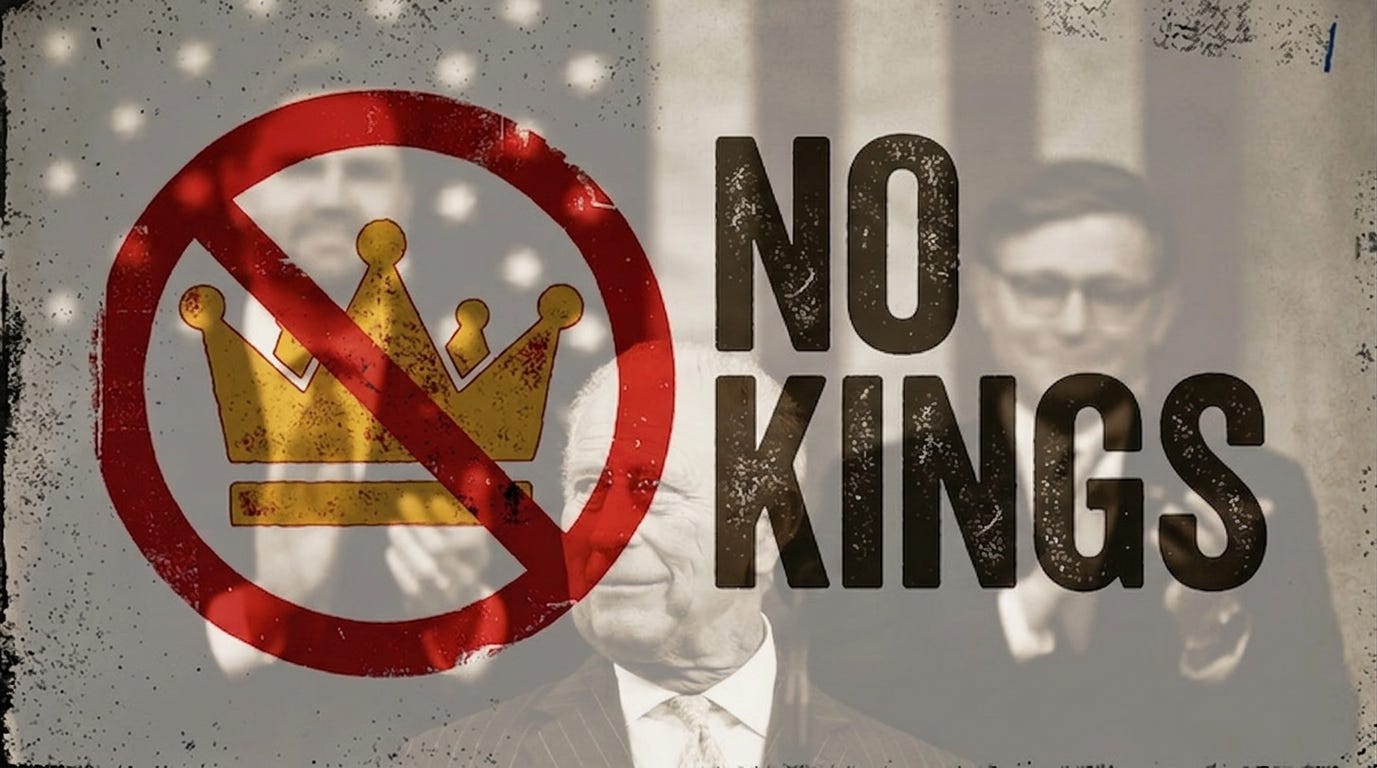
Round and round each other England and America appear to go, without any signs of stopping. But the American rejection of monarchy is fundamental and total. Despite the U.S. Supreme Court and the President appearing to perceive themselves as pretenders to their own conceptions of an American throne, there is no throne in America to pretend to.
Yours Cordially,
Joshua J. Schroeder, Esq.