


Dear Reader,
These days it can be hard to stay on your feet. You can prepare for the worst and still be thrown “off the barge” by the choices of your family, your community, or the nation itself.1 As the mind reels, it instinctively casts around for some shoreline in the past — an anchor in time — to stop the feeling of aimless drifting.
For example, when I was recently thrown and my mind began to cast about for solid ground, I landed on Carole King’s song I Feel the Earth Move, which I remember my mom listening to when I was a kid. This provoked many questions for me: Was there ever actually a time when a person’s sexual attraction was enough to leave them shook? What was the simpler world the Baby Boomer generation inhabited where sex was enough to throw a person off like an earthquake?
In these days of societal upheaval, King’s lyrics seem forced. It feels like they came from a time that was so tranquil that the small tremors of an orgasm could change a person’s whole life. But, in these days, the most pious nun in Rome would probably understand why it might be worth catching even the aftershock of an orgasm on our way to what seems to be the end of the world.
In this fraught epoch, basic human pleasure appears more as stable bedrock than fault-line. Perhaps it was the marriages of sexual partners whose gender ideologies were always at war with the other that was the cause of King being thrown so easily by the mere prospect of sex in the early 1970s. The reckless building of several lives over the fault lines that divide America, as the Boomers endeavored to do, could be the great sin for which sex and lust gets the blame.2
Fault-lines in American society that the Boomers tried to smooth over with the thrill of sexual connection are being revealed as self-destructive. Connecting with your destroyer through sex was passed down by the Boomers as nostalgia to Lana Del Ray and Ethel Cain. But maybe those who are buying this nostalgia as their anchor in the present earthquakes of America are being honest about their own position in this horror as its intended victims.
Perhaps Del Ray’s glamorization of sexual abuse in Ultraviolence, is simply a confession of Millennial nostalgia for Boomer-era sex that threatens American society. Speaking as an elder Millennial, I think we feel an obligation to remember The Deuce in order to swear off the hell it symbolized for our parents. Sex itself is not to blame for Del Ray’s nostalgic attempt to corrupt love with the violence Boomers passed down, because the thrill of sex is not the violence and prejudice depicted in The Deuce that Del Ray glamorized in the name of Hollywood icon Marylin Monroe.
Being thrown causes us to cast about for a foundation to stabilize ourselves, which led Millennial artists to turn our sights back to Boomer glamorizations of gender violence during the sexual revolution. But perhaps we do not need to embrace the divisions the Boomers failed to resolve to enjoy the stabilizing effect of sexual pleasure with those we are not divided from. Maybe we can rebel against Boomer-era nostalgia by engaging lovers who offer new ground to build a life upon without the threat of complete destruction lying at the very foundations of the lives we build.
Perhaps, our imaginations have more to offer than lingering in nostalgia for a time that never actually existed. When I enjoy new songs, my imagination often fills in better lyrics than the ones the artist chose. For example, in one of my favorite London Grammar songs, Metal & Dust, it almost sounded to me as though they sang “hope is just better than dust” where the lyric is actually “oh, it’s just metal and dust.”
I like my lyric better, but respect the artists’ choice. In my opinion, hope would have been a better conclusion than being real about an impending breakdown. When you build a life on trust, as the song goes, you are building on hope that the person or people you are building with will not betray you especially in your old age.
The creative forces of our minds can invent better paths forward by engaging in art and sex without cynically glamorizing love or beauty as though it automatically leads to or even causes death and suffering. Instead, by pushing forward upon wings of hope, human beings tend to follow love and beauty into the mystery of the great unknown. In our travels through sexual attraction and pleasure to find new families and to build new homes, death and suffering are only possibilities, while sexual awakening and life giving springs of newness and innovation are also possibilities.
A fair reading of Sylvia Plath lends even her stark poetry to this revelation. In Plath’s unabridged journals she disclosed how she was probably chasing God-like transcendence when she committed suicide. So, perhaps, it is appropriate to allow the poet who rejected the injustices of her times to provide a corrective to jog the public imagination from what appears to be a kind of desperate nostalgia-addiction:
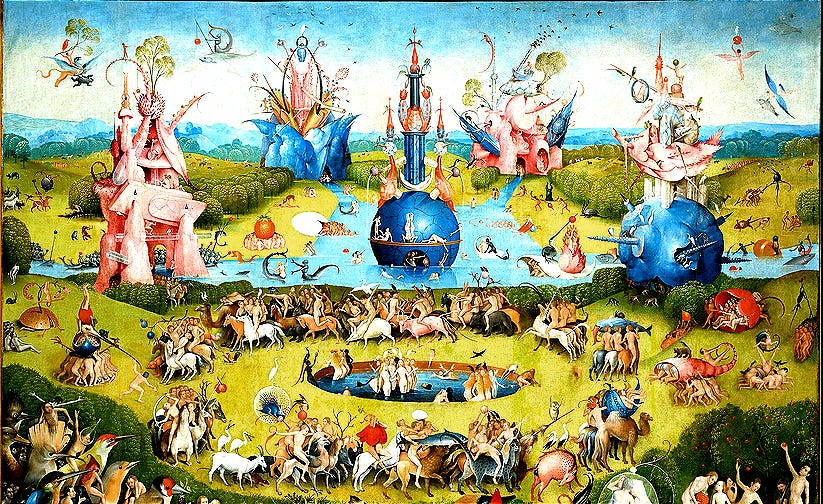
What I fear most, I think, is the death of the imagination. When the sky outside is merely pink, and the rooftops merely black: that photographic mind which paradoxically tells the truth, but the worthless truth, about the world. It is that synthesizing spirit, that “shaping” force, which prolifically sprouts and makes up its own worlds with more inventiveness than God which I desire. If I sit still and don’t do anything, the world goes on beating like a slack drum, without meaning. We must be moving, working, making dreams to run towards; the poverty of life without dreams is too horrible to imagine: it is that kind of madness which is the worst: the kind with fancies and hallucinations would be a bosch-ish relief.3
Plath seemed to be noting that if one goes mad, one might at least go mad in the style of Hiëronymus Bosch’s Garden of Earthly Delights, a triptych that is partly depicted at the top of this article. However, there are safer examples than Plath’s for imaginative exploration that did not end in tragedy. Eve Babitz and Edna St. Vincent Millay offered better, though still flawed, examples of how the imagination can help a person thrive despite the injustices of the times.
Babitz knew her strategy of imagining love where it probably did not exist was an exception in her era — a time that allowed Ted Hughes to claim Plath’s life and genius as his own. Babitz’s grand dream that the Santa Ana winds might sweep herself and her sister into the sky to fly on brooms like witches, was her hopeful counter to the general regard for “the Santa Anas as some powerful evil.”4 Re-imagining witches and wizards as the heroes of the story, was, at a very basic level, a rejection of the Boomer-era madness Plath diametrically opposed for something closer to the imaginative visual odyssey Hiëronymus Bosch bestowed to the future.
Maybe there is something in these capacities of the human imagination for me to place my anchor, to ride out the present storms when my mind is thrown in the chaos. Maybe Bosch wasn’t as mad as Plath thought he was. Maybe Plath wasn’t as mad as Plath thought she was.
Maybe Plath and Bosch’s outlandish images were the anchors of their imaginations that helped them endure the passing prejudices of their day. Maybe pleasure isn’t as radical or dangerous as the Puritans of the 1950s made it seem. Maybe the almost maniacal Puritan rejections of sex and happiness that ceaselessly popped up in American history, as depicted in the Mia Goth horror film Pearl, spread the very dangers they held themselves out as resisting.
Maybe the Puritans were mad in the worst way, because they had no imagination and hated everything that made sense. Maybe our society is an anthem of humanity’s survival of storm after storm of Puritanical abuse out of which a fruitful vine still grows by feeding on the magic of the Santa Anas and every other mythological evil tracing back to John Milton’s Satan who Phillis Wheatley conspicuously redeemed. Maybe humans construct mythological evils to scare their neighbors out of loving each other as they should, as Milton did when he appeared to make Beelzebub a romantic consort to Satan in an apparent attempt to degrade romance and sex by weaponizing public prejudice against homosexuality.
Perhaps Milton’s degradation of straight sexual love by misappropriating public prejudice was the real evil that deserved the fear that the Puritans deployed against sex itself. Perhaps Oliver Cromwell would not have been able to ruin England, Scotland, and Ireland, but for the Puritan degradation of sexual love that asked God for abuse-as-love. Maybe this Puritan desire for austerity — for a thrice battering of the heart — was always a “Satanic” prayer (in the Miltonic sense) and maybe Milton’s “Satan” is the God to which the Puritans prayed to and received this abuse of themselves as though it could be sexually gratifying to ask for self-destroying ravishment.
Or maybe this is all in my imagination.
Yours Cordially,
Joshua J. Schroeder, Esq.
I took the quote and metaphor of a barge from Babitz’s book Sex and Rage, and adopt her idea of being “thrown” by realizations that a place or group of people is/are not what she once thought causing her to jump off the barge apparently to avoid meaninglessness or a sense of aimless drifting through life: Eve Babitz, Sex and Rage 36, 85, 150 (1979).
For any who think I have left my topic of law and society behind by covering the topic of sex in society, please consider James Otis’s founding belief that the foundation of human societies is sexual attraction. James Otis, Collected Political Writings of James Otis 123 (Richard Samuelson ed., 2015) (“The same omniscient, omnipotent, infinitely good and gracious Creator of the universe, who has been pleased to make it necessary that what we call matter should gravitate, for the celestial bodies to roll round their axes, dance their orbits and perform their various revolutions in that beautiful order and concert, which we all admire, has made it equally necessary that from Adam and Eve to these degenerate days, the different sexes should sweetly attract each other, form societies of single families, of which larger bodies and communities are as naturally, mechanically, and necessarily combined, as the dew of Heaven and the soft distilling rain is collected by the all enliv’ning heat of the sun.”).
The Unabridged Journals of Sylvia Plath 1950-1962, at 210 (Karen v. Kukil ed., 2000).
Eve Babitz, Slow Days, Fast Company 76 (1977).