


Dear Reader,
Silicon Valley is known for moving fast and breaking things. Twitter is dead, long live X — and so on. Recently, its bull-in-china-shop mentality moved from the internet to the movies, to space, to the White House, to the Vatican in Rome, and to the stock market where one of its most famous acolytes, Elon Musk, was crowned the world’s first trillionaire.
Only a fraction of Musk’s wealth comes from Tesla, the electric car company that made him a household name, and his purchase of Twitter to rebrand it “X” seems to have been nothing more than a vanity project. The bulk of his value, around 99% or more, comes from SpaceX/Starlink, which holds, or held, around $38 billion in reported government contracts. Much of this government money, provided to Musk by the people of the United States, has presumably been spent over the past several years building and launching rockets and satellites into space.
As of its initial public offering, SpaceX supplied the majority of Musk’s trillion-dollar value when he raked in a reported $85.7b. The perceived money-pot that attracted the big investors seems to have been StarLink’s ability to provide global, deregulated internet access, giving SpaceX an appearance of untouchability when put in competition with foreign, highly regulated, telecom provider-competitors. But the energy Musk gives off is of the Tate-brothers’ success-by-domination variety that has all but appeared to have fizzled out in recent days, such that Musk’s projected value-inevitability may fall into the past, like the feeling that the Tate-brothers’ might have inevitably avoided criminal liability for their wrongdoing.
Giving Musk a large chunk of the United States treasury and allowing him to multiply it in the U.S. stock market is a huge bet. The bet appears to rest upon 2008’s “too big to fail” ideology, when the federal government proved it would pony up if anything went wrong with big bets like SpaceX. Almost a trillion dollars of government and private investment money that could have gone to support infrastructure, schools, transportation, updating traditional telecom networks with fiber optics, and hospitals that would benefit ordinary Americans was literally launched into space. Some of it even crashed on the moon.
The massive investments in Musk’s companies, and other operations run by tech-oligarchs including Bezos, the Ellisons, Thiel, Altman, Gates, and Zuckerberg, gives these tech bros outsized influence over the American economy. Their success will command the success of the pension funds and 401k accounts of ordinary Americans. Likewise, their failure could doom the American economy, including the property values of every common American homeowner.
So, when one of these figures settles in federal court with nearly all of the States and territories of the United States, it is never an ordinary settlement situation. Meta’s eye-popping $16.68b figure, that news sources have rounded up to potentially 17 or 18 billion dollars in settlement money to the States, boggles the mind. The shock-value of the settlement, itself, is almost certainly part of Meta’s policy strategy going forward. However, it is worth remembering that across all its platforms Meta earns around $55-60b a quarter.
By entering into this settlement agreement, Meta/Facebook admitted that it has a problem it needs to fix. In exchange, the States and Territories that were suing Meta in parallel State and federal cases over similar issues regarding Meta’s violations of laws that protect minors and children will now, apparently, back off. The result is a windfall to State and Territory treasuries that represents the value Meta places on its ability to continue providing services to American minors.
Conversely, the agreement represents the price the States and Territories put on the heads of the children that live within their bounds. According to the agreement, Wyoming’s children are worth a little over $19m, while California’s are worth nearly $2.2b. The agreement includes several policy objectives that the States and Territories hoped to enforce in Court, but now will be meted out by Independent Auditors that will theoretically ensure that Meta is complying with its end of the deal.
Meta will, apparently, pay for these audits to ensure compliance with its settlement. This sort of intrusion into a company by the government might destroy smaller competitors of Meta, and it might have destroyed Facebook in its early days. But once a company is a behemoth commanding a large portion of investment dollars in the stock market, like Musk’s SpaceX, this auditing service is an added value as legal compliance is a costly unknown traditionally borne by start-ups turned publicly traded companies, causing them to boom or bust. It appears that with its settlement, Facebook owns the de facto right to set down the anchor by which the rest of the social media company landscape will be judged, a very valuable asset.
In future litigation, assuming Meta complies with its settlement, it could characterize the settlement as an endorsement or partnership with all or most of the United States and Territories. The money amount is so large, that States and Territories would likely consider the potential direct operational consequences if they defaulted by pursuing Meta or Facebook in Court again. This is a huge added-value for Meta/Facebook to the settlement, that its smaller competitors including start-ups will not be able to shoulder — a large investment in State and Territory regulators to employ them in the the policy making apparatus of Facebook.
This settlement can be seen as a trust, purchase, or employment agreement that minimizes the costs of Meta’s business model as opposed to its competitors. It appears to contract the States to do Meta’s bidding, by inventing a uniform strategy for State-law compliance by federal court order without seeking legislation in Congress or even a State compact as the States maintain for contiguous water rights, for example. Meta’s massive payout appears to be the only unifying principle of the States to the agreement, rather than an agreement about policy or law that Congress is traditionally tasked with settling in its telecommunication and antitrust laws.
Almost half of the parties settling in California v. Meta are not parties in the suit, but have their own lawsuits pending before other Courts across the nation. Letting Meta paint with such a broad brush without requiring congressional action is huge value added to Meta. The large windfall of cash to the States potentially works to cover-up what, in reality, the settlement appears to be: a bribe.
It is an agreement that the States work with Meta, as opposed to its competitors, instead of against Meta and all its competitors alike without first addressing relevant antitrust concerns in either the State or federal legislatures. At the same time, California is attempting to block the tech oligarch family, the Ellisons’, Paramount-Skydance’s proposed purchase of Warner Bros. — a deal which contains many unusual and concerning facets including backing from the sovereign wealth funds of several Middle Eastern monarchs. Future settlements of this kind could funnel foreign, potentially hostile parties’, monies into American governments, which may confuse American officials about who they serve.
In a not-so-far-off possible future for the United States, enforcing laws to protect children and minors from illegal and dangerous policies of megalithic tech and entertainment companies could be interrupted by international affairs. U.S. wars in the Middle East, and the President’s interests in striking deals among the nations surrounding Iran, could come into play in domestic affairs that directly affect American children and minors. Money has created this house of cards, and greed has blinded those who should secure the people of America from such dangers.
The Meta settlement may give reason for the U.S. Supreme Court to expand its morality policing of social media companies through parallel actions by the FCC as well. Justice Thomas has already signaled his readiness to use unilateral judicial power to regulate major tech oligarchies through federal common carrier common law. Judging from his opinions, he would have used this power to help President Trump wage his propaganda campaigns on Twitter, and Thomas’s ideas on the topic likely have not improved in the intervening years.
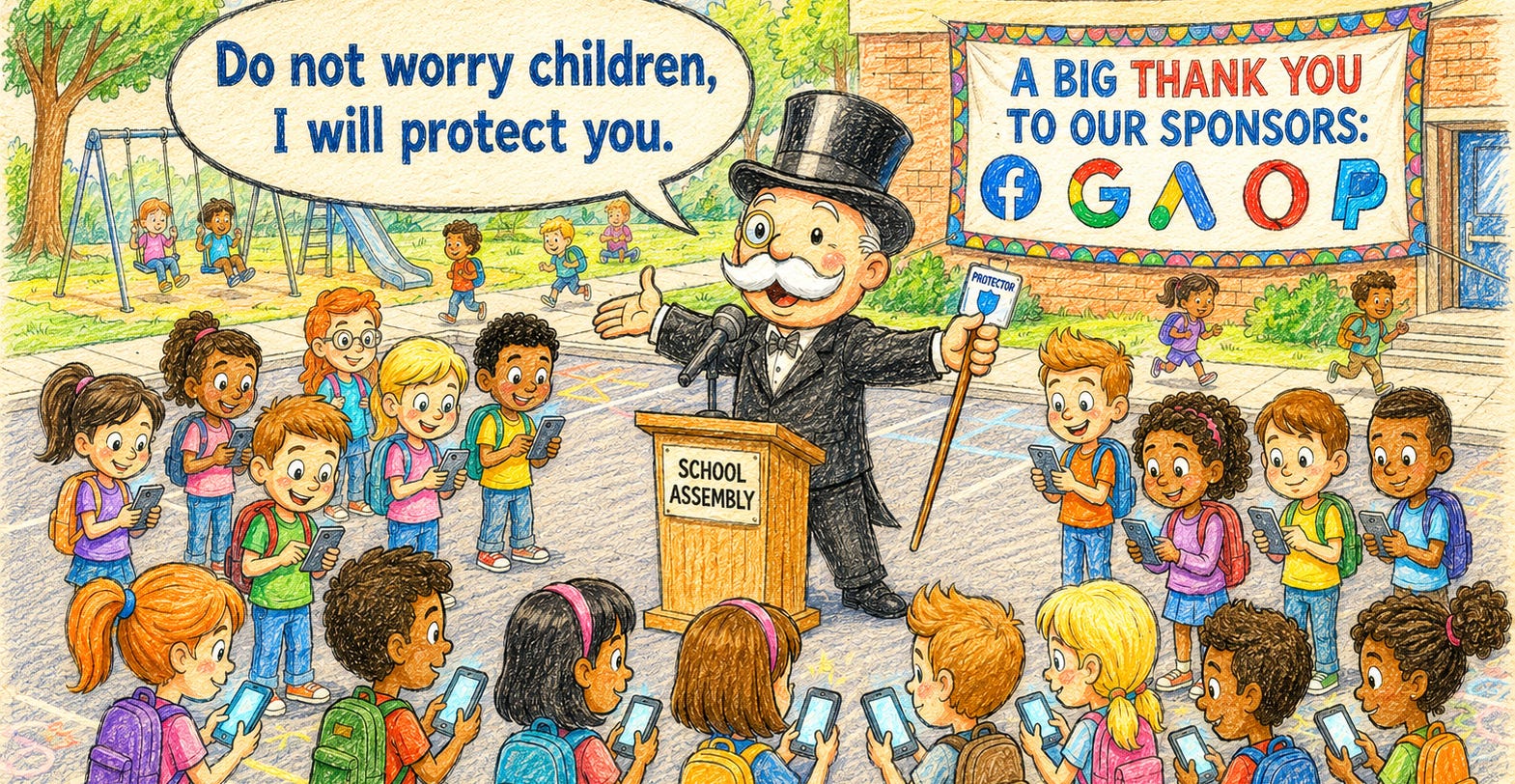
The underlying problem with the California-Meta settlement is this: There is something basically wrong with governments monetizing the pain and suffering of children and minors. The settlement avoids discussions of the legality and propriety of Meta’s decision to monetize its platform by feeding Americans propaganda and targeted ads. Instead of ending “the algorithm” and prompting State and federal legislatures to pass measures aimed at creating an equal playing field online symbolized by the initial “net neutrality” rules, the States have dealt themselves into Meta’s game by sacrilegiously invoking “the children.”
In the name of the children, the States have given themselves a monetary incentive to avoid questioning the algorithm Meta uses to monetize its users’ eyeballs. Whatever progress is gained through this settlement will be brought about because of the monetization of public online spaces for speech and expression. In the near future, American children may be taught to express gratefulness to the very thing that seems to have purchased the legal right to monetize the eyeballs of American children and minors at the settlement-auction known as California v. Meta.
The monetary nature of legal actions that regulate human life assumes there is nothing priceless about human life. The lawyers have followed a legal process and put a number on the heads of nearly all American children. The entire exercise degrades what is sacred with the business of greed to avoid questioning the real issue at equity.
The real issue always was the legality and propriety of monetizing public internet spaces — of translating mass public participation into obscene profits. There is one passage from Dave Eggers dystopian story The Circle that captures this reality. Eggers wrote of the way Silicon Valley-types regularly use reason to override the shock to the conscience of proposed tech-oligarchic policies, like implanting microchips in the bones of children:
“Mae, think about a world where there could never again be a significant crime against a child. None Possible. The second a kid’s not where he’s supposed to be, a massive alert goes off, and the kid can be tracked down immediately. Everyone can track her. All authorities know instantly she’s missing, but they know exactly where she is. They can call the mom and say ‘Hey, she just went to the mall,’ or they can track down some molester in seconds. The only hope an abductor would have is to take a kid, run into the woods with her, do something and run off before the world descends upon him. But he would have about a minute and a half to do it.”
In the Bay Area, reason and madness regularly combine in such unsettling, self-justifying diatribes. These trains of thought seek to corrupt good feelings, like the desire to protect children and mothers, to justify tyranny. Perhaps it is best to refer to my previous post about Emily Eakin’s wonderful book The Frenchmen, as she already seems to have traced the common thread of these American tirades in French theory, or maybe there is something in Ellen Ullman’s books that hits closer to home.
The point is, whatever Meta’s goals are, the people steering its ship are unstable tech-oligarchs with world views so outlandish that they may be incomprehensible to the ordinary American. It is not reasonable for government officials to enter into the games of these oligarchs when doing so may cover-up and end public discourse about whether and how the monetization of public internet spaces inherently harms children. We do not know if there are alternatives to monetizing the eyeballs of children, or of any of us, and now we may never know.
Yours Cordially,
Joshua J. Schroeder, Esq.