

Dear Reader,
Donald J. Trump is a teetotaler; he says he has never had a drink and has never smoked. This makes Trump’s alleged sex abuse scandals, general use of cuss words, slander, and other flagrant breaches of etiquette eerie products of abstinence rather than substance abuse. Even more paradoxical, is the throng of devout teetotalers who support Trump’s empowerment of notorious substance abusers to misappropriate some of the strongest language English contains to preserve the status quo.
Some of Trump’s closest followers in this regard are Democrats. The appropriation of English swear words by mainstream Democrats who argued Joe Biden was defending the “soul of the nation” was unexpected, because their rejection of their previous development of political correctness (“PC”) seemed to admit on its face that Biden-as-American-soul-warrior never passed the laugh test. And calling Justice Ginsburg the Notorious RBG would have worked in the 1990s, but today it comes off as what it appears: boldfaced pandering.
In short, the attempted rebrand of Democrats as non-PC backfired, giving little or no political payout. Meanwhile, the Republican Party paradoxically remade itself as the official anti-PC party when it dumped the Bushes along with their facially PC family values platform for Trump’s freewheeling-wrecking-ball platform. Now Trump is recklessly reducing some of the most electrifying English terms — like hope, change, revolution, social justice, and equal liberty — into milk toast.
If English terms continue to be abused in Trumpian style, the entire English language could fall into meaninglessness. The wonderful BBC documentary HyperNormalisation anticipated this problem of a people paralyzed by the normalization of radical realities from a psychological angle, that I rebrand here as “radical normalization” to address its legal-linguistic underpinnings in the English context. If my legal research holds, the English language has an ace up its sleeve that could help both Great Britain and the United States avoid a needless era of radical normalization or hypernormalisation where English itself may lose its ability to convey any real sense of the extreme.
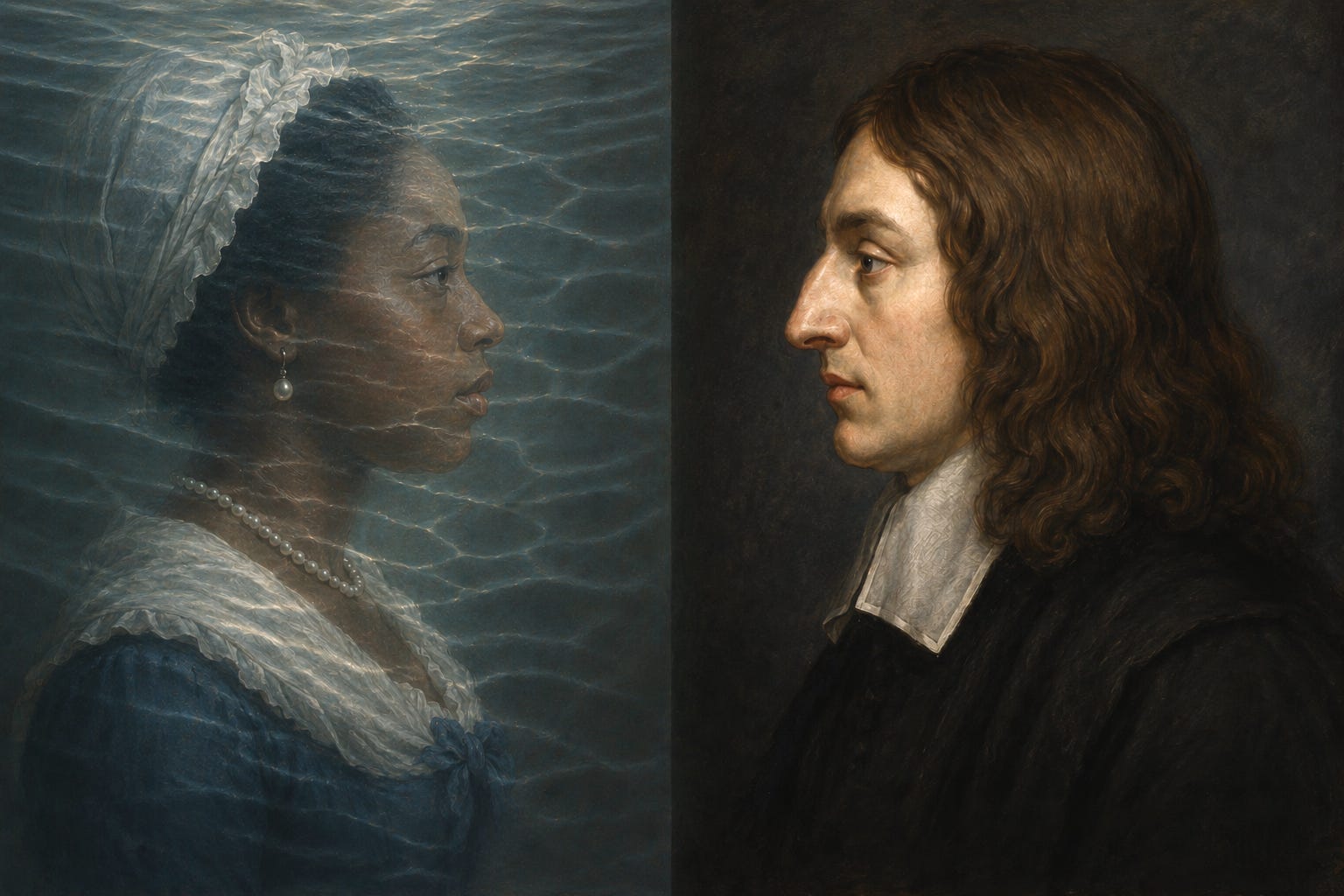
After the renowned Puritan poet John Milton appropriated some of the most raunchy, sexual images in Camus, Paradise Lost, and Samson Agonistes to degrade the rights of women, many lost hope. For a time, misogynists reigned supreme as the English language itself seemed to tilt against the recognition of equality of women in public life while Milton steered the ship.1 But when the visionary poet Phillis Wheatley read Milton, she successfully charted a path through him into what is now known as the Romantic art form.2
On July 4, 1776, the Americans followed Wheatley’s lead and the United States was born through an unlikely path charted through the paradoxes of Milton’s Puritanical sex God. This sublime journey of faith through the impossible gave us the First Amendment, the Patent & Copyright Clause, and many other advances in statecraft. By charting her poetic course through Milton’s “boundless systems . . . Thro’ earth, thro’ heaven, and hell’s profound domain,”3 Wheatley recreated Milton’s Satan into a tragic hero that became the foundation of the Romantic art that later reverberated throughout Europe in the writings of Goethe, Longfellow, Dumas, Blake, Keats, Lord Byron, and the Shelleys, among many others.
Admittedly, there is insufficient direct historical evidence to unequivocally prove that Phillis Wheatley was the necessary link that drew Puritanical doom-saying into Romanticism’s future providential, allegories of love. Yet, Wheatley’s poetics were a conspicuous precursor to Romantic art that revolutionized Puritanical dirges into elegiac forms of encouragement to help the American Revolutionaries persist through their tribulations.4 In the times in which she wrote and the medium of Puritanical elegy that she chose, Wheatley took the world’s stage completely alone.
In time, Wheatley may be recognized as a singularity that caused a Romantic revolution in Europe for which white men primarily took the credit. In the autumn of 1772, Wheatley constructed Romanticism’s chrysalis in the fires of a trial where she unanimously won her right to claim credit for transforming the Puritan elegy from mere drudgery into a prophecy of change that fully manifested on July 4, 1776. In a few short months, she presaged transformations that would later be wrought by the American Revolution itself by traveling to England where her artistic form emerged transfigured — rippling out its global influence like a sable butterfly that unexpectedly initiated hurricanes of Romantic art across Europe by the unassuming flutter of her delicate wings.
For most of its history, the American judiciary also exhibited a tendency to absorb Black genius while keeping itself primarily white and male. It is well known that Reverend Pauli Murray strategically masterminded the legal framework the all-white and all-male U.S. Supreme Court adopted in Brown v. Board of Education, which the Court recently drew into question in Louisiana v. Callais. The Court’s controversial decision in Callais marked the end of an especially toxic Romantic era in American legal history when the charms of Black Americans were monetized by and used to burnish the reputations of white Americans without paying for a license.
The American judiciary’s culture has drastically changed from the last days when revelers like Justice Antonin Scalia and the Notorious RBG promoted a paradoxical sense of blusterous levity from the bench. Scalia, especially, would entertain the public by fanning himself like Scarlet O’Hara to protest the big, mean liberals, while boisterously lambasting his colleagues (especially Justice Kennedy) as usurpers and tyrants. Ever since his passing, however, the Supreme Court supplanted Scalia’s humorous self-contradiction with a bottomless sense of white grievance and fragility that is confusing to navigate.
In retrospect, Scalia and Ginsburg’s political-revenge themed revelry appears to be the last dregs of Justice Holmes’s Romanticism to be express from the American bench. The Court confirmed, in Callais and several other recent cases, that its sense of white grievance has no limit — effectively ending the era of Holmesian Romanticism that limited white grievance with the requirement of a humorous punch-line (however terrible the consequences an ill-humored judgement might be). As Wheatley knew, by Jefferson’s admission, when white men concluded that no God would support their systems of racial oppression they tended to abandon any sense of levity to throw caution to the wind as Justice Alito did in Callais. They seemed to decide that since they are going to hell anyway, like Cain who murdered his brother, they should make the most of the lives they have.
In his book Stamped from the Beginning, Ibram X. Kendi observed this fatalistic pattern in white America by explaining how the American slaveholders adopted the legend of Cain and the Land of Nod. These slaveholders misappropriated the Bible to justify chattel slavery laws upon Cain’s murder of his brother Abel by re-imagining Cain as the proto-slaveholder to create a sense of white grievance for themselves as heaven’s outcasts. Phillis Wheatley resolved this legend in her revolutionary poem On Being Brought From Africa to America where she re-imagined Cain as a redeemable Black man to destroy the legal basis for chattel slavery in this biblical legend.
Kendi, and his “woke” allies in The 1619 Project, not only rejected Wheatley’s magnanimous extension of God’s grace to white America, but they failed to recognize Christianity’s role in the anti-slavery phalanx of the American Revolution. In response, Reece Jones wondered at The 1619 Project’s inexplicable embrace of the KKK’s fatalistic retelling of American history that sought to erase the existence of Black American Revolutionaries like Wheatley.5 The “woke” crowd gained nothing for characterizing Wheatley as a mere circus act to flatter Thomas Jefferson’s racist dismissal of her poetry as though she did not leave her many American admirers, including Thomas Paine, George Washington, Benjamin Franklin, James Bowdoin, Samuel Cooper, and David Wooster, wonder-struck.
As Wheatley achieved a clear victory against slavery in the Revolution of 1776, not even the American South still perceives that arguing from a position of Cain’s murder of Abel was ever a valid argument for white superiority. This caused a mutilation in how all Americans read historical sources that covered up their real meaning even when they are openly presented before our eyes. For example, John Marrant’s characterization of slaveholders as our “modern Cains” in a sermon he preached in Boston 1789 appears to modern eyes as a sleight against slaveholders, because modern eyes see Cain as a moniker of complete hubris and illegitimacy.
But as Kendi himself noted, the slaveholders long held a view that Cain’s position as outcast of heaven made him into a tragic figure that was not entirely dealt with until the Union won the Civil War. In fact, Kendi maintains it is not entirely dealt with even now in the 2020s. However, in Marrant’s time, the reference to Cain referred to a mainstream and generally known appeal of slaveholders to Cain as a tragic figure, not an invention of Black America to lambaste slaveholders.
This misinterpretation of Marrant as flipping the script rather than saying it how it was, causes modern readers to see Marrant as more revolutionary than he was by seeming to turn the tables on the slaveholders. By the same token, Wheatley’s actual turning of the tables gets misinterpreted as piteous supplication, or, at best, as Grace Nichols’ “skin teeth.” The worst sin of these misreadings is that it let Thomas Jefferson off the hook by interpreting his saying that God would never side with slaveholders as a confession implying a desire for redemption rather than a recapitulation of the old Cain-based method of maximizing injustice through white grievance.
Therefore, Kendi’s mistreatment of Wheatley is a travesty,6 but as Professor Karla V. Zelaya noted, Kendi’s error seems to be based in a common misunderstanding of what Wheatley was doing in her works. In response to Wheatley’s successful revolution of Miltonic poetics, post-revolutionary white supremacists, like Rudyard Kipling, gradually shifted their use of the story of Cain and Abel to continue validating a sense of white grievance by associating themselves with Abel, as the murdered party. Kendi noted this counter-narrative that “circulat[ed] throughout England and the English colonies” in tracts that “wrote of Cain, or ‘the Southern man,’ as a ‘black deformed elf,’ and ‘the Northern white, like unto God himself.’”7
It is impossible to draw a straight line through the paradoxical ways the Cain and Abel story justified racism. Yet, racism itself was always paradoxical, in one hand justifying the importation of Black people to America for enslavement and on the other banishing them back to Africa to preserve white hegemony under the guise of teaching Africa to be civilized.8 These paradoxes were fully formed in the 1852 case Dred Scott v. Emerson where Justice William Scott absurdly held: “As to the consequences of slavery, they are much more hurtful to the master than the slave.”
Callais is a direct descendant of this unbelievable absurdity of white grievance, which sits at the root of all Dred Scott v. Sandford’s errors. The absurdity of white Americans claiming to be victims of their own power and privilege arbitrarily controlled Callais’ decision that enforcing the Voting Rights Act of 1965 would violate the Equal Protection Clause as racism against white majorities. As Wheatley once said: “How well the Cry for Liberty, and the reverse disposition for the Exercise of Oppressive Power over others agree, — I humbly think it does not require the Penetration of a Philosopher to determine.”
Intentional gaps left in the historical record of Wheatley’s work explains how mid-century American culture, like the 1989 classic Dead Poet’s Society, could feature Robert Herrick’s famous line “gather ye rosebuds while ye may” without acknowledging the way American slaveholders lived out the dark side of carpe diem. Herrick’s smarmy attempt to convince young Puritan women in 1600s England to betray their morals by sleeping with him revealed the dreary Puritan aesthetic as merely the accoutrement of a prevalent proclivity in 1600s England and America for deflowering virgins. Thus, the chattel slavery that occurred in America has a peculiar foundation, or at least a correlative, in paradoxical Puritanical poetry that seemed to spurn sex by fetishizing celibacy and even sexual abuse.
The performance of white male power in the bedchamber, symbolized by Jefferson’s rapes of Sally Hemings and his enslavement of his own children by her as an apparent remedy for Cain’s white male grievance against God, became the origin of U.S. immigration law in the Page Act of 1875 and the White Slave Traffic Act of 1910. Of course, it was controversial when Wheatley imagined white supremacists might be redeemed on what is potentially a sex positive basis. Yet, Wheatley endeavored to transform white supremacists into agents of Black liberation by retelling John Milton’s sex-obsessed story about sin and redemption in a way that would allow them to go straight to hell and then rise again out of their sin and error as forgiven and redeemed.
Callais resurrected the white grievance Wheatley and her followers opposed when it extended Dred Scott’s implicit conclusion that Wheatley failed to win over the intentions of enough white men to be legitimately considered one of the Founders of the United States. However, Wheatley inspired the Declaration of Independence in several ways, including by her inspiration of General David Wooster’s commission of a 1774 anti-slavery sermon The Religion of the Revolution and who later sacrificed his life in service of a multiracial future for America. Thus, Callais and similar recent decisions symbolize the success of propagandists and provocateurs who remade the Wooster-Wheatley alliance into a weak and failed attempt to disrupt to overarching pro-slavery purposes of the American Revolution, which should offend everybody.
Against the travesties of Kendi and The 1619 Project, Wooster’s blood cries out from the ground. The sacrifices of blood in the Revolution of 1776 still vindicate Wheatley’s defense of “the heaven defended race.” Her white followers, who bravely faced their own mortality for the hope of a real metropolitan providence rising from the complex multicultural American society of the 1700s, still venerate her revolution of the English language to save it from the Puritans of our day.
Yours Cordially,
Joshua J. Schroeder, Esq.
Note About the Topic of Language Discussed Above: Neal Allen’s Rule 6: Prefer Anglo-Saxon Words from Neal Allen and Anne Lamott’s wonderful book Good Writing: 36 Ways to Improve Your Sentences, anticipated the topic of radical normalization addressed in this post. Therein, Neal demonstrated that English, as a conquered and dominated language, has an almost spiritual slant toward the original words of the Native Anglo-Saxons, almost as if the language itself was made for for speaking back to one’s conquerors with words that cut to the heart and blood of a reader. As an attorney and legal scholar, this aspect of English etymology is clearer to me than most because my profession developed the English language that describes the Conquest of 1066 as the “catastrophe which determine[d] the whole future history of English law.”9 It was into this development of the law of Native Anglo-Saxons after the Norman Conquest that Neal’s rule derives its validity, because English itself tends to favor the words of the Natives to those of the conqueror. The discourse between Phillis Wheatley and John Milton addressed in the post above over the fate of the English language’s most extreme terms in the 1600s and 1700s, which has its own legal dimension, also engages the reasons for Neal to suggest the Anglo-Saxon words.
See, e.g., John Quincy Adams, The Social Compact 25 (1842) (quoting Milton’s depiction of Eve to exclude women from the promises of Massachusetts’ social compact).
Joshua J. Schroeder, Leviathan Goes to Washington: How to Assert the Separation of Powers in Defense of Future Generations, 15 Fla. A&M U. L. Rev. 1, 159-60 (2021) (“Against the blindness of these men, Phillis Wheatley revolutionized Milton and became a better champion for the freedom of mind than Milton’s lady ever was, abolishing any reason why Miltonic thought should disfranchise her sex.”).
The Collected Works of Phillis Wheatley 144 (John Shields ed., 1988).
John C. Shields, Phillis Wheatley and the Romantics 23-24 (2010) (piecing together the potential underpinnings of Wheatley’s moves that presaged the Romantic era to come).
Reece Jones, White Borders 6 (2021) (“There is a surprising amount of agreement about the racial history of the United States between anti-racists and white supremacists.”).
Ibram X. Kendi, Stamped from the Beginning 94 (2016) (characterizing Phillis Wheatley as a mere “exhibit[]” as an “exotic creature[] in [a] racist circus”). This error seemed to arise from Henry Louis Gates, Jr.’s previous error of misrepresenting the Englightenment’s rejection of Black humanity as a consequence of the Black person’s apparent incapacity to reason, when Hume and his Englightenment followers Kant, Hegel, and Jefferson rejected Black humanity by theorizing that Black people could not feel and therefore could not feel the whip or the strain of work. Id. at 95 (quoting David Hume’s Of Natural Characters); Henry Louis Gates, Jr., The Trials of Phillis Wheatley 13 (2002) (noting Kant’s expansion of Hume’s theory: “The Negroes of Africa have by nature no feeling that rises above the trifling.” (emphasis added)); id. at 12, 14 (erring by presenting reason, rather than passion, as the measure to which the Bostonians measured Wheatley’s capabilities: “The question of whether Africans were human was less related to color than the poessession of reason.”). Gates was correct to point to Descartes as a preeminant European rationalist, but whether or not Descartes’ proof of reason “I think, therefore I am” succeeded or not would not have proved or disproved Descartes’ humanity, which is fortunate as Descartes’ simplistic route to Rationalism, and potentially Rationalism itself, seems to have been debunked. Id.; see Daniel Kahneman, Thinking, Fast and Slow 40-42 (2011).
Kendi, supra note 6, at 37.
Phillis Wheatley had to respond to both these forms of racism by simultaneously rejecting invitations to be sent as a missionary back to Africa and by rejecting the slaveholders’ access to Jefferson Davis’s access to a lionized verson of Cain-as-white. In these paradoxical emanations of racism, the pro-slavery half seemed to adopt the Davis version of Cain being the proto-slaveholder while the anti-slavery half seemed to imagine Cain as a backwards Black sub-human. Wheatley’s poem rejected both by making Cain Black, but also by making him equally redeemable as anyone else in the angelic train. Wheatley, supra note 3, at 18.
Sir Frederick Pollock & Frederic William Maitland, The History of English Law Before the Time of Edward I 86-87 (1898) (explaining the particular nuance of the English language caused by the Norman Conquest, which was that “all our words that have a definite legal import are in a certain sense French words”).