

Dear Reader,
Louisiana v. Callais’ attack on the enforcement of duly enacted federal law nullified several judgments in contravention of Allen v. Milligan’s old vindication of statutory stare decisis. As a direct result, Allen was subsequently stayed in the shadow docket while the Court re-decides Allen as though its previous decision mandating a supercharged form of stare decisis did nothing. In a sense, Callais put every federal law, policy, and precedent in a position of double jeopardy that can be changed at any moment by ad hoc review — in other words, Callais is Dobbs on steroids.
The legal profession was generally unprepared for Callais because it was a recapitulation of the Slaughter-House Cases’ invention of The Anticanon. The anticanon facilitated a peculiar growth in lawyerly laziness beginning in the decades after Slaughter-House — a case that deemed Dred Scott overruled by the Thirteenth Amendment, while paradoxically upholding Dred Scott’s racist construction of the Declaration of Independence that excluded Black Americans. Once a case is tossed into the anticanon, as Slaughter-House did to Dred Scott, few take the time to understand exactly how the case went wrong or why we consider it worthy of anticanon status.
Slaughter-House, and its progeny currently ending in Callais, could have overruled anticanon cases, but that would have required the Court to describe why the decisions were wrong the day they were decided — void ab initio. Slaughter-House did not describe why Dred Scott was wrong the day it was decided. Had it done so, it would have had to extend broader rights to Black Americans pursuant to the Fifth Amendment and the Privileges & Immunities Clause, the Guarantee Clause, the Ninth Amendment and other sources of rights that existed when Dred Scott was decided. Slaughter-House’s invention of the anticanon to, in part, avoid explaining Dred Scott’s error demonstrated its role was more to preserve unjust decisions like Dred Scott than anything else.
Nevertheless, the anticanon appears to be an effort to avoid making the perfect be the enemy of the good, by attempting to maximize the number of people who agree that Dred Scott was wrong without rubbing their noses in why it was wrong. Yet, even in the light most favorable to the anticanon, it seems to be basic post-racialism by another name. Instead of answering the question of why Dred Scott was wrong, it endeavored to negate Dred Scott by recapitulating Dred Scott’s negation of good and evil in an end-of-history, Hegelian-absolute-idea sort of fashion.
Even though Dred Scott was marinated in Hegelianism, I am not one to seriously consider Hegel (or the woke crowd that seems to follow him these days) a “sorcerer” as Eric Voegelin did. Nor do I think of Hegelians as completely lost once they “enter[] into the magic circle the sorcerer has drawn around himself.” At the very least, the term “sorcery” is a term loaded with too much Puritanical baggage.
Calling something sorcery or magic merely to mark it as evil is self-contradictory, because being magical implies that evil is actually an interesting or beautiful thing. But the Hegelian dialectic as infamously carried out in Dred Scott and repeated in Slaughter-House is anything but beautiful or interesting. The utopian logic of the so-called Hegalian dialectic in both-and logic is extremely tired and boring, especially because it has not created a utopia and shows no signs of leading humanity to utopia.
After centuries of trial and error, Hegel’s old idea that a utopia will flow from humanity’s absolute paradoxes seems to be mere fatalism clothed in optimism. The Hegelian dialectic seems to be the systematized form of “toxic positivity” analyzed by Mary Trump as the primary symptom of Donald Trump’s religious beliefs. The toxic positivity of the American Puritans who hanged witches in Salem conspicuously prefigured Hegel’s later establishment of both-and logic as the foundation of his utopia machine.
The banality of evil can be dressed up by people hoping to vindicate good as a secular utopia just as it can be dressed up with mighty vanquishing angels tearing down the battlements of the devil in an epic scene of war. We saw this in the Salem Witch Trials and we see it today when so-called Christians dress up global war and unrest as though it has a deeper meaning in the unbiblical concept of rapture and Armageddon. But when actual people are demonized or vilified as if they were the great Satanic host God is meant to smite in the end times, they tend to come out looking more like clowns than devils — as Eichmann did in Jerusalem.
The paradoxical thinking behind Callais that is clearly rooted in horrible decision after horrible decision linking back to Dred Scott is actually too banal to address in a Substack post like this. The logic is so boring that it cannot be exhaustively addressed without losing every single reader to sleep or distraction. As Hannah Arendt noticed, in this “banality” lies evil’s real power.
If Arendt was right, banality is probably why Slaughter-House basically got away with extending Dred Scott’s central holding in the same breath as it recognized Dred Scott was invalidated constitutionally. It is also probably why Brown v. Board of Education got away with letting Plessy v. Ferguson live on. And it was also probably why The 1619 Project basically agreed with the KKK about white supremacy being a founding U.S. principle while holding itself out as an enemy of the KKK.
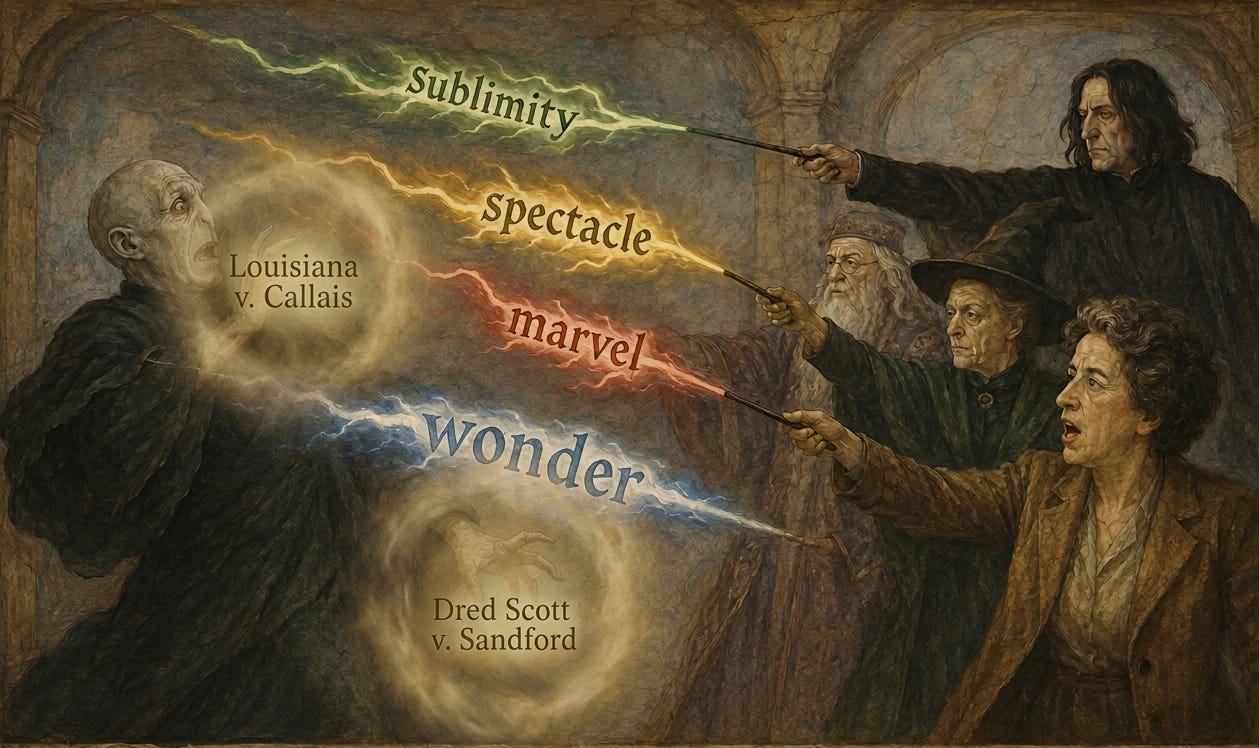
To use a concept from Harry Potter, banality seems to have been why Voldemort’s horcruxes worked so well. Voldemort was able to hide pieces of his soul in plain sight so that he could potentially live on forever. The items Voldemort cursed were not, in-and-of-themselves evil, but the effectiveness of his curses depended on the items remaining extremely mundane.
Voldemort’s undoing came about largely due to his choice of corrupting objects that retained some sense of flavor or interest that clued in the story’s protagonists — a goblet of Hufflepuff, a diadem of Ravenclaw. Being objects of interest or even glamour was the power of good at work, because only good can be marvelous, captivating, or sublime. So too in the law, when Callais corrupted the one person, one vote ideal the power of good tips off social justice advocates because the ideal of one person, one vote is interesting and thought provoking.
Thus, Callais came from the banality of Hegel’s presumption that good will automatically appear from holding tension between absolute opposites like slavery and freedom as in the problematic writings of W.E.B. DuBois. Instead of continuing to trust the process of Hegelain double-consciousness, Americans should take Arendt’s advice and seek for something new. Hopefully it is not too late to hunt for horcruxes in Supreme Court precedent to stop the Supreme Court from needlessly repeating the heinous errors of its checkered past.
As the end of the 2025 Supreme Court term approaches, when many highly anticipated decisions will be issued, we can be sure that whatever is decided will be explained away in Hegelian style. The subordination of Black voters will probably be explained as just part of the process of majority rule that the Founders and Framers allegedly adopted when they started the nation. Instead of raging aimlessly against a machine that is already built up around a long-standing anticanon that allows the Court to avoid having its gravest errors explained publicly, artists, writers, and musicians could expose the anticanon as a boring, drab, and altogether gauche judicial attempt to avoid naming its part in some of the most horrifying wrongs of American history so that we do not repeat them.
It is time to dream as Martin Luther King, Jr. dared to dream. Great dreams are not usually infested with the colorless banality of Hegelian philosophies that promise utopias and give only mediocrity as the Court did in Callais. If a great dream catches fire in the American mind, it can disrupt even the most deeply embedded horcruxes of federal jurisprudence, even now.
It should inspire hope that America’s salvation from its present struggles could be one big dream away. Many examples of American muses could be cited, but I think Kesha is the artist who most inspires my mind to dream greatly. May her voice throw a light into your imagination as it has done for me, and then, if you want, share your big dreams with me by sending me a private message or making a comment below.
Yours Cordially,
Joshua J. Schroeder, Esq.