

Dear Reader,
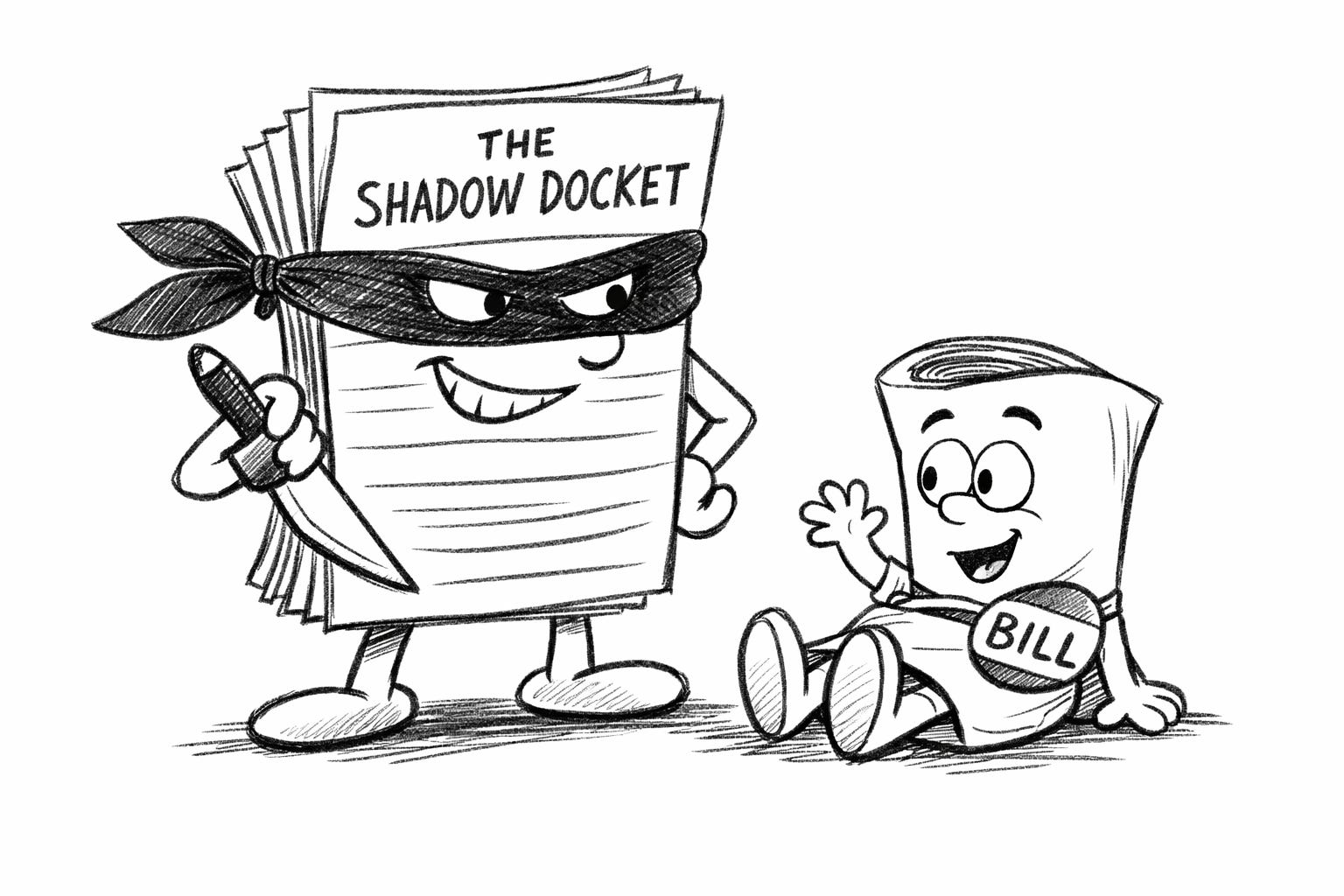
Contrary to popular belief, the existence of the so-called “shadow docket” does not trace back to a law, regulation, precedent, or constitutional provision. Rather, the “shadow docket” is a rhetorical device deployed by legal commentators to criticize the arbitrary and apparently lawless behavior of the Supreme Court of the United States (“SCOTUS”). It is a present-day version of the “chancellor’s foot” that exists in the genre of provocative critique à la The 1619 Project.
The term “shadow docket” was first invented in a 2015 law review article written by Professor William Baude.[1] According to Baude, his part in creating a memorable pejorative for the equity docket was his particular reaction to the 2013 SCOTUS Term. As Baude reported: SCOTUS in 2013 was a total bore; Burwell v. Hobby Lobby “was not even a constitutional case”; the whole affair was “a fizzle rather than a bang.”[2]
With a yawn loud enough to disturb Hannah Arendt from her slumber, Baude implied that banal topics should be left alone and that he was the proper aesthetic judge of what is banal.[3] Baude’s criticism of Hobby Lobby as humdrum, was his way of refusing to disturb the decision in Hobby Lobby with his criticism of the shadow docket. Thus, Baude critiqued Wheaton College v. Burwell as bad “shadow docket” behavior, while using claims of banality in an attempt to stave off any fallout arising from his critique to the law decided in Hobby Lobby.[4]
Baude was justified in criticizing the Wheaton College injunction as shadow docket meddling even if his reports of boredom can now be read as tongue-in-cheek. Others, including myself,[5] were slow to begin criticizing the corruption of equity in the Supreme Court as “shadow docket” behavior.[6] Part of the reason for the delay has been that not everyone agrees with Baude’s apparent underlying belief that the Supreme Court’s equitable power is tantamount to a god-like sovereign prerogative power to issue “lightning-bolts” from on high.[7]
The constitutional limits of the American system require that equity is administered after laws are made, whether by statute or common law, to ensure cohesion with the higher laws, rights, obligations, and privileges enumerated in the constitution.[8] The very fact that American governments are limited governments by design, and that the Court’s equity is charged with the duty of enforcing those limits, calls into question Baude’s whole commentary about judicial equity being an unlimited prerogative power. Nevertheless, it appears that many jurists, like Baude, believe that the royal prerogative is alive and well in every branch of U.S. government.
The fact that Baude is one of Chief Justice Roberts’ former clerks might allow us to infer that this is how Roberts sees judicial power. Equity is vested in the Court through a statute and limited by the constitution, but the Court has overreached, time and again, tracing back to the antebellum in-chambers issuance of habeas corpus in Ex parte Merryman.[9] America’s most illogical and self-contradictory jurist, Chief Justice Roger B. Taney, issued an opinion accusing President Lincoln of king-like tyranny from chambers to justify the release of a terrorist suspect without argument, opinion, process, precedent, or law.[10] The Civil War began in earnest only after Taney ensured that there was no possible way to peacefully resolve the nation’s differences in Court.[11]
The Reconstruction Court repeated this error in Griffin’s Case, where Chief Justice Chase reversed the issuance of a habeas corpus writ to release a Black man convicted for assault with intent to kill by a Confederate Judge during the Civil War, who refused to take an oath of loyalty to the United States after the Civil War.[12] In Griffin, Chase denied the writ without argument, opinion, process, precedent, or law according to an opinion that solely focused on the potential unfairness to the Confederate judge who might have lost his job otherwise.[13] The Court bent itself into pretzel shape to extend job security rights to Southern traitors at the expense of the fundamental rights of Southern Black patriots to freedom.[14] This was how the “shadow docket,” used here as shorthand for equity-corruption, survived beyond the Civil War.
By the time Chief Justice Taft introduced the writ of certiorari as the primary method of Supreme Court review, the shadow docket was already well-established in America.[15] Thus, Professor Steven Vladeck’s wonderful analysis of later shadow docket activity is not reliable as to the origin story of the shadow docket. Nevertheless, Vladeck’s book about the shadow docket remains an indispensable resource that covers mid-Twentieth Century shadow docket corruption.
The shadow docket officially began in Baude’s law review article, and the equity-corruption it refers to, began, or at least culminated first, in Merryman. This means that the Court’s liberal and open-ended ability to review habeas corpus under § 14 of the Judiciary Act of 1789, now known as the All Writs Act, codified at 28 U.S. § 1651, seems to have been corrupted to reshape the equity docket into a shadow docket.[16] It appears that the Suspension Clause, of all things, may have protected the Court’s power to be evil in the Arendtian sense of that word.
One more sidelight might help to illuminate this origin story. If the shadow docket is short hand for equity corruption, then it exists at every level of the Court that has equitable power—not merely at the Supreme Court level. My scholarship eventually embraced the general definition of the shadow docket as short hand for equity corruption at potentially every level of the federal and state courts as symbolized by Merryman and Griffin.[17] But my original piece addressing the equity docket that also reviewed the 2013 Term did not attack the equity docket as Baude had done.[18]
Unlike Baude, I thought the entire 2013 Term, which I had read in its entirety, was revelatory.[19] Thus, on the outset of my legal career, I drafted and distributed what I then labeled the Equity Memorandum to warn the legal profession of the Supreme Court’s radical trajectory in 2013.[20] This Equity Memo was later published in its entirety under the title America’s Written Constitution, which emphasized the role of equity in securing the promises of Marbury v. Madison according to the Court’s duty to say what the law is—a duty that Baude and his ilk have dangerously taken for granted.[21]
Yours Respectfully,
Joshua J. Schroeder, Esq.
[1] William Baude, Foreword: The Supreme Court’s Shadow Docket, 9 N.Y.U. J. L. & Liberty 1, 5 (2015); Stephen Vladeck, The Shadow Docket xii (2023) (noting that “[i]t was William Baude, a conservative constitutional law professor at the University of Chicago (and former law clerk to Chief Justice John Roberts), who first used the term ‘shadow docket’ as an evocative shorthand”).
[2] Baude, supra note 1, at 3 (concluding that “the term’s cases were not as dramatic or far-reaching as in previous years”).
[3] Id. (claiming that the judgment came from “observers” and not himself); but see Joshua J. Schroeder, America’s Written Constitution: Remembering the Judicial Duty to Say What the Law Is, 43 Capital U. L. Rev. 843, 846 (2015) [hereinafter Schroeder, America’s] (noting “a radical reformative discussion of fundamental judicial rules” in the 2013 Term cases).
[4] Baude, supra note 1, at 7. Days after Hobby Lobby decided that for-profit corporations have religious liberty rights to refuse paying for contraceptive coverage, Wheaton College successfully applied for and received an injunction from the Supreme Court allowing a corporate religious liberty right to obstruct its employees from receiving contraceptive coverage. This injunction allowed a private corporation to effectively nullify legal provisions designed to secure statutory rights to contraceptive medical care. The decision in Hobby Lobby did not grant Hobby Lobby the power to nullify the laws, but the decision to allow a for-profit corporation a religious exemption from paying for contraceptive coverage was premised on the assumption that statutory provisions directing the federal government to pick up the tab, left by exempted corporations, would not be effectively nullified by the same class of corporate religious rights.
In Wheaton College, ostensibly the same corporate religious rights at play in Hobby Lobby were extended without argument, process, decision, precedent, or law to enforce a corporation’s willful obstruction of the statutory and regulatory provisions that were designed to secure contraceptive coverage of employees not covered by religious employers. There was no law, no precedent, no argument, no process, and no opinion to justify the activism done in Wheaton College. This was the beginning of the derailment of stare decisis with ad hoc decision-making now symbolized by the “shadow docket” pejorative invented by Baude.
Several decisions after Wheaton College similarly drew Cooper v. Aaron into question by facilitating the nullification of law and precedent without argument, process, decision, precedent, or law. In Whole Woman’s Health v. Jackson, the Court nullified Roe v. Wade before it was overruled through the equity docket. In CASA Inc. v. Trump, the Court nullified United States v. Wong Kim Ark unless or until each individual U.S. Citizen sues to protect their own citizenship, while it effectively issued a universal injunction to deny relief to a nationwide class in DHS v. D.V.D. pending litigation. And finally, in Cook v. Trump, the President asked SCOTUS to allow him to define “due process” as posting on Truth Social, a social media company the President owns, and allowing Lisa Cook to respond on Truth Social as her constitutionally mandated opportunity to be heard regarding her removal from the Federal Reserve Board.
This line of cases call for a deeper review than is possible in this article. Despite the fact that each of these decisions are classic shadow docket shenanigans, the legal issues they involve go wide of the present topic of the origins of the shadow docket. Therefore, more about the Lisa Cook case, the future of administrative due process in America, internet freedom, Religious Freedom Restoration Act case law, and the nullification crisis and potential destruction of Cooper v. Aaron will be addressed in forthcoming content here at Everything at Issue.
[5] See, e.g., Joshua J. Schroeder, The Dark Side of Due Process: Part II, Why Penumbral Rights and Cost/Benefit Balancing Tests Are Bad, 53 St. Mary’s L.J. 649, 655 (2022) [hereinafter Schroeder, The Dark].
[6] See generally Vladeck, supra note 1.
[7] Baude, supra note 1, at 51, 55 (citing John Harrison, Pardon as Prerogative, 13 Fed. Sent’g Rep. 147 (2001)).
[8] See, e.g., Luther v. Borden, 48 U.S. 1, 52 (1849) (Woodbury, J., dissenting) (“Constitutions and laws precede the judiciary, and we act only under and after them, and as to disputed rights beneath them, rather than disputed points in making them.”).
[9] Ex parte Merryman, 17 Fed. Cas. 144, 145 (C.C.D. Md. 1861) (Case No. 9,487) (noting how “a writ of habeas corpus was issued by the chief justice of the United States, sitting in chambers”), explained by Seth Barrett Tillman, What Court (if any) Decided Ex parte Merryman?—A Correction for Justice Sotomayor (and others), 13 Br. J. Am. Leg. Studies 1, 17–18 (2024).
[10] Merryman, 17 Fed. Cas. at 150–51 (comparing President Lincoln with Charles I who was beheaded as a tyrant and citing the laws of Charles II as the apparent basis of American habeas corpus review); cf. Chambers v. Florida, 309 U.S. 227, n.10 (1940) (critically, tracing the legal lineage of the American Suspension Clause to anti-feudal English sources prior to the statute Merryman relied upon for justification).
[11] See generally Dred Scott v. Sandford, 60 U.S. 393 (1857).
[12] Griffin’s Case, 11 Fed. Cas. 7, 8 (C.C.D. Va. 1869) (Case No. 5,815).
[13] Id. at 9, 27 (noting that the writ of habeas corpus was to be issued by the Chief Justice of the Supreme Court “sitting at chambers”).
[14] Id. at 20 (defending the rights of Mr. Griffin’s judge to make a living as a treasonous judge in America based upon the laws of British conquest (citing Campbell v. Hall (1774) 98 E.R. 1045 (Eng.))); id. at 22 (noting that the appeal of the grant of habeas corpus was made by a Confederate Judge Sheffey in the underlying case, whose lawyers were allowed to argue that British feudal law justified the destruction of a Black man’s rights in the South and it worked). It is a complete mystery why Baude, Tillman, and Vladeck who all apparently disagree with each other regarding the Court’s recent interpretation of Griffin’s Case in Trump v. Anderson did not address the radical, royalist, treasonous, and racist bases for denying Mr. Griffin habeas corpus relief.
[15] Vladeck, supra note 1, at 29.
[16] Merryman, 17 Fed. Cas. at 147 (“The application of this case for a writ of habeas corpus is made to me under the 14th section of the judiciary act of 1789 [1 Stat. 81], which renders effectual for the citizen the constitutional privilege of the writ of habeas corpus.”)
[17] See, e.g., Schroeder, The Dark, supra note 5, at 655.
[18] Schroeder, America’s, supra note 3, at 836, 859 (addressing the concept of feigned legal positivism that took hold during the 2013 Term only to be dramatically ripped away by the Wheaton College injunction).
[19] Id.
[20] Id. at 833 n.*.
[21] Compare id., with Baude, supra note 1, at 1.