


Spoiler Alert: This post contains spoilers of the Apple TV show Pluribus.
Dear Reader,
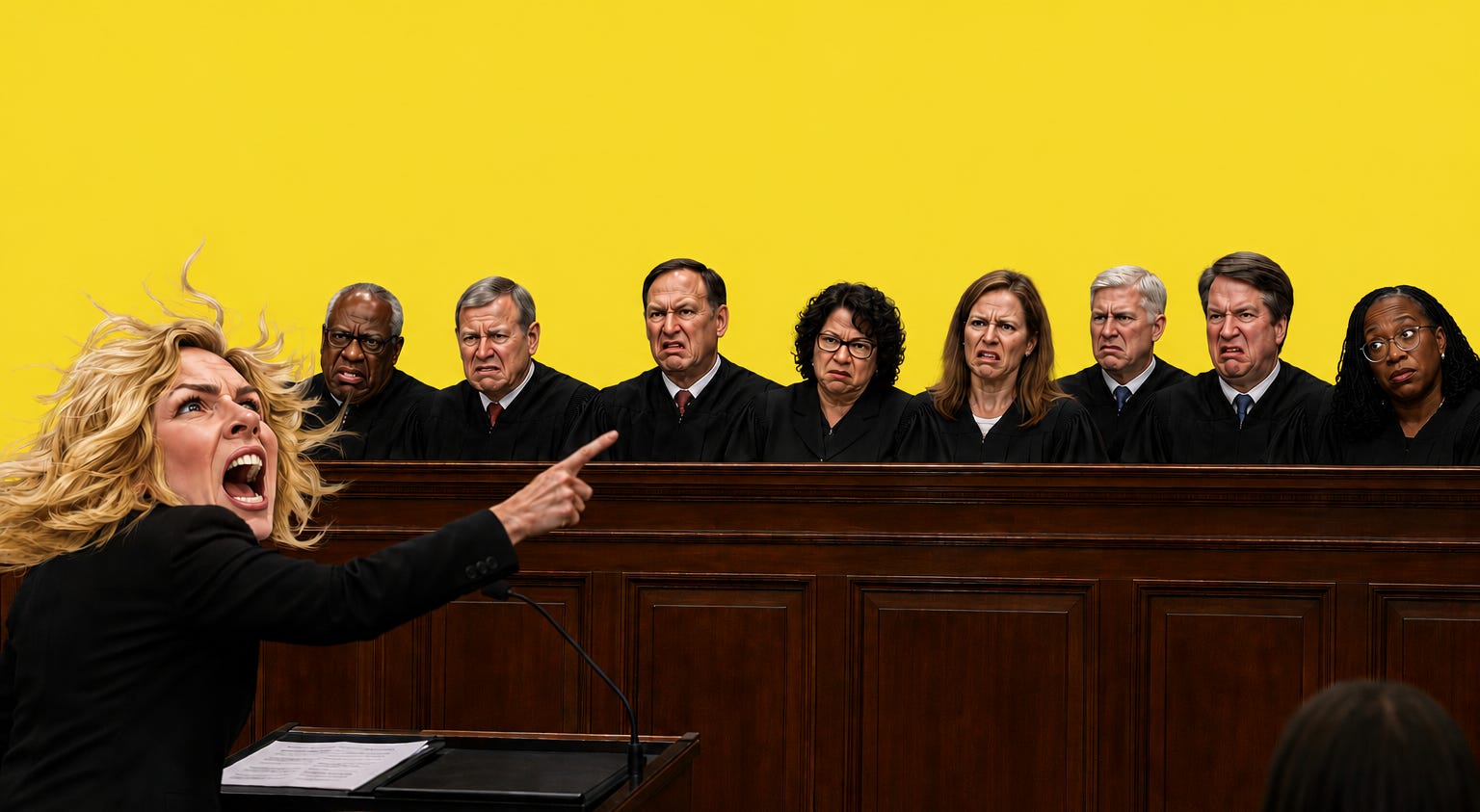
Despite being aware of the paradoxical times we inhabit, I was initially surprised by what people were saying about Louisiana v. Callais in the news. Some diagnosed Callais’ requirement of intentional discrimination as its “darkest sin,” but that was the least of its problems. Realizing that the public was not being told how Callais mutilated the Equal Protection Clause and how it nullified the Voting Rights Act of 1965 was more horrifying to me than Callais itself.
When I tried to process the radical errors in Callais with my sounding board, they expressed worry that if I wrote about it I would alienate everybody (including them). Upon hearing this, my mind snapped back to a scene in Pluribus where Carol Sturka (Rhea Seehorn) failed to convince her fellow human beings to resist an alien invasion. Remembering how Sturka alienated other humans by, perhaps, too harshly interrogating the alien invaders, I balked.
In the past, James Baldwin inspired my boldness to face difficult realities, because “nothing can be changed until it is faced.” And I’ve recently discovered Anna Quindlen who seems to support my choice to abandon “the protective coloration of the expectations of those around” me. But as my sounding board feared, and as Sturka demonstrated, facing the actual horror of Callais too zealously could deflate public support for my scholarship and potentially delay the changes I hope to inspire.
When I predicted legal development correctly in my scholarship, I would emphasize it as boldly as I could to generate more offers to publish. I was privileged with a legal platform where I published scholarship that embodied the ideal of legal prediction laid out by Justice Oliver Wendell Holmes, Jr., even as I criticized him. But the zeitgeist has fundamentally shifted.
Assassinations and assassination attempts are on the rise, and political insiders have started eating their own. People are more tense and reactive than they have ever been in my lifetime. In this new context, law reviews and news outlets are sensible of the reality that legal prediction can be blamed in the aftermath of tragedy for radical insensitivity, recklessness, or even cruelty.
The horror of Pluribus similarly rests upon the possibility that the United States so irrevocably betrayed its ideal of individualism that the rest of the world would rather succumb to an alien invasion than listen to another annoying American. It also seems to align free choice with inevitable doom, as though humanity’s ultimate failure is a result of our freedom. Yet, without a hope that the actions of a puny individual human being like Sturka might create meaningful change for the rest of humanity, the horror of Pluribus would fade into mere tragedy, romance, or lust.
But Pluribus is not a story about how to cope with inevitable doom like Euphoria. It did not veer into religious themes to give unavoidable tragedy some sort of meaning in our lives. Rather, Pluribus sought to captivate its viewers by forcing Sturka to face the radical jeopardy her unique freedom seems to put upon the human race without revoking the hope that Sturka’s feeble efforts could, even accidentally, create a positive effect for everybody.
Perhaps my desire to remain authentic about where we really are as a nation, while still pushing for social justice, will ruffle feathers. And perhaps those who built their careers upon the insistence of their own authenticity, like Quindlen, will defend my steps, or, at least, I can hope they will peruse my writings. To me, being a free thinker who publishes work for consideration by free thinkers is success.
Throughout her career, Quindlen consistently defended enforcing the terms of one’s own success and happiness. When critics called her crazy, Quindlen issued a defense of all free American thinkers against any similar fabricated charge of insanity in a speech to the 1999 graduating class of Mount Holyoke College where she said:
But I am not nuts. I am happy. I am successful on my own terms. Because if your success is not on your own terms — if it looks good to the world but doesn’t feel every day good in your heart, it’s not success at all. Remember always the words of Lily Tomlin: “If you win the rat race, you’re still a rat.”
Perhaps my general rejection of the proverbial rat race is what worries my sounding board most, and perhaps it is also what makes them beam with pride. Remaining authentic in a time that rewards manufactured white grievance can be scary. But I think Quindlen was right. Even if you are not leading major revolutionary movements like Phillis Wheatley or banking huge monetary rewards for your work, you can still be happy.
That said, I have taken the note. It may no longer be safe to run headlong into arguments and observations that might have secured more publishing contracts for me in a previous era. Perhaps, public authenticity by any means necessary was always a fool’s errand and a Millennial fantasy that unfairly burdened Gen-Z with an impossible standard of self-expression.
Authenticity should never be standardized as some kind of benchmark, because performative authenticity is inauthentic. It would also be oppressive to presume that everyone has the resources to afford authentic expression when a growing number of Americans must be inauthentic in order to survive. But as for me and my own, I will repeat Quindlen’s words as a sort of benediction to my own situation: “I am not nuts. I am happy. I am successful on my own terms.”
Yours Cordially,
Joshua J. Schroeder, Esq.