


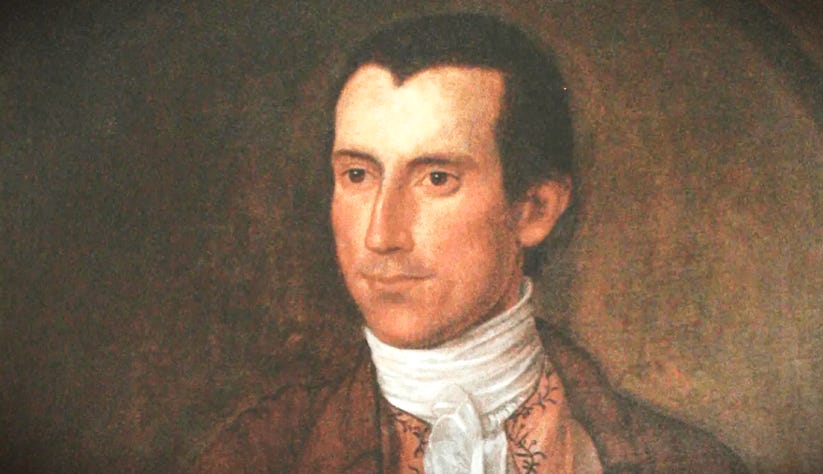
The Author is counsel in cases that touch on the topics discussed in this piece. The Author wrote a research paper on this topic entitled St. George Tucker’s Unlimited Common Law.
Dear Reader,
Of all the American paradoxes advertised in The 1619 Project, perhaps the most diabolical was that it turned back to Virginia only to declare all America a “slaveocracy.” Turning back to the founding era in the South, to hear what it had to say for itself, was not an error. But selling itself as the authority on the South, without doing a proper investigation of the South, was a fraud.
Thomas Jefferson’s hypocrisy on the issue of slavery will always be the focus of those most bedeviled by despair in America. It is a horrific marvel that the man most responsible for drafting the Declaration of Independence’s words “all men are created equal” for the entire nation did not overcome his own contradictory prejudices and severe moral failures. But Jefferson was only one Virginian among many.
Perhaps, it was auspicious that Jefferson was in France when the U.S. Constitution was drafted and ratified. Other, more hopeful Virginians took the reins during the time the U.S. government was formed out of the dross of such Jeffersonian prejudice and cynicism. Against the advice of Jefferson-in-France, James Madison supported the ratification of the Copyright & Patent Clause that secured the rights of authors the Black American Revolutionary Phillis Wheatley had recently convinced the entire English speaking world to uphold in her favor.
And, St. George Tucker directly responded to Jefferson’s racism by citing the Scottish philosopher James Beattie, who imagined that Black people could be equal human beings, capable of moving the human heart with sublime artworks. Many radical arguments, now considered mainstream, filled Tucker’s legal tracts. For example, Tucker argued that the original Privileges & Immunities Clause in the Articles of Confederation included Black citizens and it might have given them a basis to vote in Virginia, as voting was a fundamental right of the citizen.
Only after American Reconstruction failed, would the U.S. Supreme Court deny Tucker’s belief that voting rights are fundamental citizenship rights. This happened in Minor v. Happersett, which denied that the Fourteenth Amendment’s Privileges or Immunities Clause should constitutionally protect the voting rights of women. The Supreme Court’s denial of the equal voting rights of women under the Fourteenth Amendment required the Court to contradict Tucker’s earlier ideas, which he based upon Lord Coke’s construction of the legal term liber homo (“freemen”) to include females in the rights protected by the American common law.
Tucker also set forth a plan for freeing all Virginian slaves. In his anti-slavery advocacy, Tucker noted that Virginia alone had more free black Americans in its borders than all the Northern States combined at the time of his writing around 1800. Black people who fought in the American Revolution were admitted as freemen, and, despite Jefferson’s horrible duplicity, most of the American Revolutionaries, including his fellow Virginian George Washington, seemed to think that Black people would soon be made free throughout the United States according to the Declaration Jefferson himself wrote. And President Jefferson seemed to reveal that he believed this as well when he announced to the world that three non-white U.S. Naval officers were native U.S. citizens amid the Chesapeake-Leopard Affair.
Instead of investigating how Jefferson’s cynicism and hypocrisy upended mainstream intentions for the freedom of all Americans originally set forth in the Declaration of Independence, The 1619 Project positioned the British Royalists as a legitimate option for those seeking freedom. Nevermind the fact that most of the Black soldiers who defected and joined the Royalists were mistreated and left to die on Gwynn Island, receiving their “liberty” with death. Nevermind, as well, the role of British racism in the propaganda that called for the domination of all Americans as a sub-human species created by a mythical high rate of miscegenation that never appears to have existed in the American Colonies.
The 1619 Project actually repeated a misnomer caused by Jefferson’s self-serving inflation of the number of slave defections in Virginia. In fact, far fewer Black Americans joined the Royalists than Jefferson claimed, which he had only claimed because it might mean that he and his fellow slavers could plead no fault in losing their property in the face of creditor suits. America’s largely British-funded slave market might not have been able to send out collectors on American slave-loans if the slaves were effectively released by the British, which, again, was a ruse concocted by Jefferson to avoid his foreign debts.
The games Jefferson played to keep his fortune, properties, and status surely cost him his soul. But not every Virginian joined in his moral downfall. St. George Tucker appeared to stand against these errors at every turn, and believed that eventually justice would prevail in the South.
Yet, Tucker was a consistent Southerner. When Madison and Jefferson’s Democratic Republican Party was targeted by the Alien & Sedition Acts, Tucker went to work in their defense. As a respected federal judge in Virginia, he sent an influential letter to Congress explaining the high error of the Alien & Sedition Acts by contemplating the expansive use of the word “person” in the Fifth Amendment to include all people, regardless of color or gender.
Tucker even raised John Randolph, an influential intersex Congressman, who led the impeachment effort against Justice Samuel Chase. Randolph claimed his step-father Tucker had abused him imperiously, forcing him to be a man and to fit male stereotypes when Randolph was naturally effeminate. Randolph rose to some of the highest levels of influence and power in early America by claiming the pronouns “he, him, his,” but after he perished, an autopsy confirmed the long standing suspicions of most everyone in Congress that something was different about Mr. Randolph.
Despite Randolph’s complaints about his step-father, he liberally cited to Tucker’s arguments against an unlimited common law in Chase’s impeachment trial. He used his step-father’s name and reputation to build a career for himself serving Jefferson, and later Andrew Jackson. Randolph’s boldness in the prosecution of corrupt officers, including Presidents and Justices before Congress, came directly from St. George Tucker’s play book.
In Tucker’s tracts, he clearly stated that Presidents could always be removed and tried for treason — something that ought to be remembered today even after the atrocity of Trump v. United States. In the context of the Alien & Sedition Acts, which unconstitutionally criminalized speech in favor of the party not in power, Tucker had his eye on the unlimited nature of the common law as it existed, or appeared to exist, in England. Some had argued that the Alien & Sedition Acts did nothing more than codify the unlimited English common law in America.
Tucker single-handedly invented a theory, now embraced in a long line of U.S. Supreme Court case law, that the common law exists in each State, but is not embraced as an unlimited source of power in the general government. This line of thinking appeared to run against the Northerner James Wilson’s ideas expressed in his original decision in Chisholm v. Georgia, which extended the common law writ of assumpsit to out-of-state suitors litigating against a sovereign State. But Tucker’s approach quickly ran into the debacle of Justice Samuel Chase’s impeachment for, essentially, rejecting the common law basis of American rights as given in the Declaration of Independence.
Tucker seemed to agree with Chase’s dissent in United States v. Worrall about there being no general common law in the federal courts to prosecute crimes not codified by statute. But when these crimes were codified by statute in the Alien & Sedition Acts, Chase went full bore, apparently, imposing his will upon juries that seemed ready to acquit individuals prosecuted for First Amendment protected political speech. This bad, anti-democratic behavior is why Chase became the first member of the U.S. Supreme Court to be tried for high crimes and misdemeanors in Congress.
Tucker’s ideas about the limited nature of the American common law abetted the impeachment effort taken up by his step-son John Randolph. However, unlike Chase who seemed to believe in nothing but practical realities of power, Tucker believed in the limited American common law. By refusing to give Americans a fuller conception of what the common law of America ought to be, as Justice James Wilson did in his lectures, Tucker was able to address the errors and corruptions of common law that America explicitly rejected pursuant to its social compact of 1776.
For example, in one passage Tucker cited paragraph nine of the Declaration, which announced King George III’s refusal to naturalize foreigners and to encourage their migrations to America as a basis for immigration rights in the United States. Tucker carefully examined the Colonial promises made to foreigners by former English monarchs prior to the Revolution, and noted that the king’s double-crossing of these age-old promises was one of the causes of the American Revolution. Immigration rights, formerly secured by feudal law in America, had to find their existence in the new limited common law of America without the help of royal graces.
This meant that the States provided the first naturalization statutes almost immediately after independence was declared, and prior to the ratification of the Naturalization Power in the U.S. Constitution. Tucker carefully explained how, initially, Virginia announced all of Virginia’s inhabitants citizens by requiring them to take oaths of allegiance, followed by a short period controlled by statutes that sought to exclude women, non-white people, the sick, and the poor. Finally, however, Virginia opened its doors by repealing its racist, misogynist, and bigoted naturalization statute for an open invitation to all foreigners to naturalize regardless of color, religion, gender, health status, or economic class.
Why did The 1619 Project fail to emphasize this early victory in Virginia for multiculturalism and social justice? Likely, its creators did not know about it, because the American academy did not adequately focus on Tucker’s contributions. Opportunities to talk about intersex figures like Congressperson Randolph in the early Republic also likely were not even known to the creators of the project.
Ignorance is acceptable as long as it is accompanied by a dedication to wonder about what is still unknown. But the creators of The 1619 Project unwisely positioned themselves as authorities over topics they have proven not to have studied deeply, or at all. In fact, the very author The 1619 Project claimed as its primary inspiration, Lerone Bennett, Jr., stressed that those imported on the White Lion in 1619 were indentured as servants, as legal equals, Black and white.
The racial difference in the treatment of American servants and slaves was first developed in Virginia around 1700 and later in other American Colonies, as a reaction to the multiracial Bacon’s Rebellion of 1676. Presenting this multiracial history is largely left to white men like the author of The Invention of the White Race Theodore Allen. Thus, some white men, including Allen, maintained that W.E.B. Du Bois was wrong about white Americans in Du Bois’ despondent work The Souls of White Folk, because some of us actually do rise in defense of our very souls.
In fact, some white men in the deep South abetted the vivacious sounds of the Jazz and Blues, likely because they wanted to claim their positions as participants in the creation of America’s most notable contribution to culture. Jefferson himself was sensible that it was white slaveholders who were damned, because they would be the most impossible for a loving God to potentially save. When and if we manage to rise from the hells American slaveholders created on earth, it will be more miraculous-seeming than DuBois presented.
So it would seem now, as the U.S. Supreme Court is captured by conservative politicians, Congress is asleep, and a divisive former TV reality show host is the President. What a miracle it would be if these people, these awful Americans, managed to overturn the last vestige of the Alien & Sedition Acts that is still on the books: the Alien Enemies Act. The matter is before the Court now.
The 2026 Term will likely decide the issue of habeas corpus jurisdiction over Alien Enemies Act cases that began in 2025 when President Trump invoked the statute for the first time since World War II. If Tucker’s founding opinion is followed, then there is no general common law in America as exists in England to justify such a statute, and the statute must finally be struck down. But, it seems, this Court is more likely to hypocritically cite to The 1619 Project as a source of founding wisdom than to the founders themselves.
Yet, again, these doubts give rise to the miraculous-seeming nature of the possibility they may choose better in the future according to Tucker’s founding wisdom. Many recent decisions about there being no general federal common law, which unsettled the viability of the Alien Tort Statute and Bivens v. Six Unknown Named Agents may also provide a basis to strike down the Alien Enemies Act. The Court’s so-called “Originalists” need only find the links referred to here that Tucker painstakingly elucidated to his contemporaries in the early Republic.
If the Roberts Court fails, as it is likely to do, it remains important to note what it might have done in this time of upheaval according to its own opinions. Should the Supreme Court cause a constitutional failure, Congress is empowered to reform the Courts accordingly. And should Congress fail to check the Court and the President as the former seems to be crowning the latter a king, Tucker specifically maintained that the people in the United States retain the national sovereignty. “We the people” retain the power to form and reform the government as was first announced in the Declaration as a right and duty “to throw off such Government, and to provide new Guards for their future security.”
Yours Cordially,
Joshua J. Schroeder, Esq.