
Dear Reader,
The New York Times’ new report about the origins of the “shadow docket” in a 2016 matter about environmental law suffers from several anachronisms, not least of which was Professor Baude’s invention of the term “shadow docket” in 2015. However, the bombshell reporting of the Times is an undeniable confirmation of the existence of the shadow docket, if “shadow docket” means equity docket corruption. In their new report, the Times’ revealed several confidential memos between the Justices of the U.S. Supreme Court that demonstrated how political the use of judicial equity can be.
After this report, there was a sense of public betrayal as Chief Justice Roberts is known to support the enforcement of etiquette in the Supreme Court to promote the appearance of collegiality. Yet, the memos the Times’ exposed told a different story about how the Chief Justice tipping the scales in favor of his own political views on a close 5/4 split where the minority expressed serious misgivings. However, Chief Justice Roberts’ misuse of Dred Scott v. Sandford in Obergefell v. Hodges already exposed the Chief Justice’s emphasis on etiquette as a redux of Chief Justice Taney’s old strategy for covering up political abuses of the judicial role.
Chief Justice Taney, author of Dred Scott, was known for enforcing Southern-styled manners in his Court while he presided over cases that accused President Lincoln of monarchical tyranny and nationalized slavery law. Roberts, likewise, held himself out as opposed to Dred Scott, while using Dred Scott to undermine substantive Due Process rights in Obergefell. Similarly, in Trump v. Hawaii, Roberts symbolically interpreted Korematsu v. United States as “anticanon” by deciding it was “overruled in the court of history,” in a decision that closely paralleled the reasoning in Korematsu.
Those who have read their jurisprudence would know both Taney and Roberts are not the cordial, professional, or courteous people they appeared to be on the surface. The Times’ reporting merely broke the spell of appearance-driven-etiquette that was broken at least once in the American past when the U.S. Supreme Court’s role in causing the Civil War became widely acknowledged after Dred Scott. But the use of manners, warm feeling, and even flattery to achieve potentially society-ending results like Dred Scott is still under-discussed.
America’s general failure to discuss this phenomenon opened the opportunity of a renewed public relations defense of the dignity and honor of the Court by dogmatically opposing any attempt to nullify anything a judge decides or even thinks. Even built in, structural methods of nullification like juries are blasted as dangerous and unlawful when they appear to unsettle a judge’s position regarding the law. But this pro-judge dogma appears to be waning now that the false-courteousness of men like Chief Justice Roberts is being loudly decried in the public square.
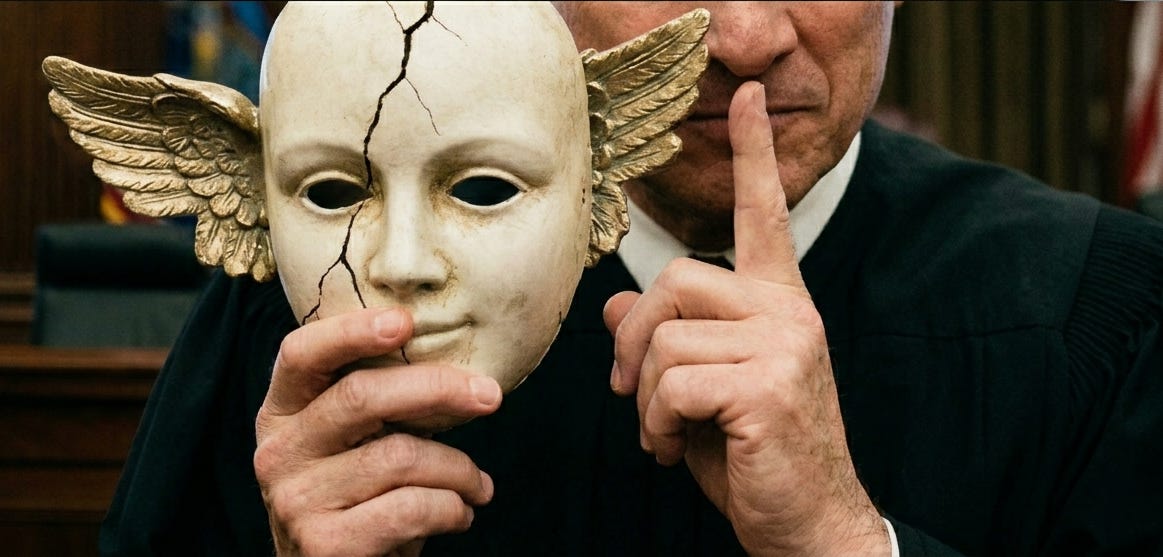
Now that the Court’s mask of good manners appears to be slipping, it is time to reconsider nullification. What is it, and why do judges seem to hate it so much? And, more specifically, why was nullification painted, by some, as though it were exclusively a tool of racism and bigotry, when the anti-nullification crowd has a clear history of upholding racism and bigotry in the Taney Court era?
For example, in Ableman v. Booth — one of the cases that led up to the Civil War, the Supreme Court tried to stamp out an apparent attempt to nullify the Fugitive Slaves Act of 1850 in the State of Wisconsin. The injustice of Ableman, and the unconstitutionality of the federal law it protected, appeared to cause some scholars to conclude that legal nullification is not always a bad thing. The power of the Court to strike down unconstitutional laws symbolized by Marbury v. Madison validates this perspective, and the jury’s apparently unreviewable power to administer mercy through “nullification” also seems to support it.
During the ordinary function of free and healthy societies the occurrence of legal nullification should be rare. The Court emphasized this in its iconic decision Cooper v. Aaron, which unanimously enforced Brown v. Board of Education in the face of threatened nullification by the State of Arkansas. Instructive as Cooper was, it erred by extending Ableman as though it were not a clearly unjust decision thrown into doubt by the Civil War itself.
To be clear, Ableman could have, and should have, struck down or at least distinguished the Fugitive Slaves Act of 1850. Doing so might have avoided the need for a Civil War according to a long held opinion in the South (that spread Northward in Winny v. Whitesides and Westward in Mason v. Smith) that a slave was once free, always free according to the judiciary’s overarching object of “insur[ing] domestic Tranquility.” Despite 20/20 hindsight, and the recent talk of the so-called “anticanon,” ever since the Slaughter-House Cases the Supreme Court mostly “celebrated” Dred Scott v. Sandford and other illegitimate decisions that caused the Civil War.
Thus, the Cooper v. Aaron Court voted to enforce Brown v. Board of Education by venerating Ableman. The Cooper Court could have easily made use of the postbellum case Ex parte Young, instead of Ableman; i.e., its reliance upon Ableman was completely needless. And now, Cooper’s reliance on Ableman is a problem as Cooper is frequently being drawn into question to justify political abuses of the Court by rushing to fait accomplis in the shadow docket to corrupt the merits docket in favor of anti-abortion state laws and anti-birthright citizenship opinions of the President.
The Cooper case was drawn into question several times in the so-called “shadow docket.” Dissents in Whole Woman’s Health Organization v. Jackson and Trump v. CASA, Inc. both referred to the majority opinion as a threat to Cooper. But Cooper was threatened in other shadow docket decisions despite the lack of reference to Cooper in a dissenting opinion in many cases like the one recently reviewed by the Times: West Virginia v. EPA.
In another such case, Wheaton College v. Burwell, the Court drew Cooper into question by enjoining the federal law from stopping a private party’s unilateral nullification of the law. Cooper was also threatened in DHS v. D.V.D., where the Court effectively issued a universal injunction to block courts from protecting remedies for laws being nullified by the President of the United States. The universal stay/injunction in D.V.D. followed days after its decision in CASA to deny that the Court has power to issue universal injunctions—both of which effectively threatened Cooper by fostering nullifications of the law.
The Court-led nullification of federal laws appears to be unique to the Roberts Court. In all previous eras, the President and the States were the primary nullifiers of the laws. The Framers of the U.S. Constitution did not fathom that, in the future, a Court might be the cause of its own collapse, nor did they guess the role of etiquette in dangerous judicial nullifications of law for political reasons in both the Taney and Roberts Courts.
But the sheer failure to address these known issues in all the time after the Civil War, when the issues might have been raised, is most telling about who is guilty of wrong in America. The blind continuation of Dred Scott in Justice Thomas’s infamous bid to end substantive rights through the Slaughter-House Cases in Dobbs and beyond relieves the Founders and Framers of the brunt of the responsibility for our problems. The Framers of the U.S. Constitution empowered us to amend government form where we find it fundamentally flawed, and so we might have chosen, and still might choose, to save ourselves from this Court of false etiquette and unjust nullification.
Yours Respectfully,
Joshua J. Schroeder, Esq.